

The best Solana passive income options include native SOL staking, liquid staking via tokens such as JitoSOL and jupSOL, holding JLP and JUICED tokens, and financing real-world payment activity through Huma Classic.
Native staking is the simplest option for long-term SOL holders, especially given SOL’s price volatility. JLP and private-credit products can offer higher yields, but they also carry other types of risk, while JUICED offers a stable yield on idle assets.
Rates were checked on October 1, 2026, and can change at any time.
| Option | Yield snapshot | Yield source | Best for | Principal risk |
|---|---|---|---|---|
| Native SOL staking | 4.7%–5.23% | Protocol inflation, transaction fees, and MEV rewards | Long-term SOL holders | SOL price decline |
| Liquid staking | 4.85% | Protocol inflation, transaction fees, and MEV rewards | Long-term SOL holders who want instant liquidity or to use their SOL as collateral | SOL Price decline and smart contract risk |
| JLP | Around 10.17% variable return from Jupiter Perps fees | 75% of Jupiter Perps fees | High yield passive income | JLP price decline and protocol risk |
| JUICED | 5.0% | JupUSD lending and reserve income | Earning stablecoin yield while waiting to deploy capital | Stablecoin depeg and smart contract risk |
| Huma Classic PST | 8% base rate | Short-duration real-world payment financing | High stablecoin yield through off-chain borrowing | Borrower and liquidity risk |
Native staking is the simplest choice with the lowest risk, excluding SOL price volatility. Liquid staking is an excellent option for capturing SOL staking rewards and using the liquid SOL as collateral to borrow against. JUICED offers the cleanest stablecoin yield by simply holding the token in your wallet, and JLP captures Jupiter Perps fees to increase its value, while Huma offers a higher stablecoin yield to offset additional credit or lending risks.
How I selected these five options
I compared multiple passive income options on Solana and selected the top five that didn’t use leverage, since I wanted minimal investment risk. Additionally, I wanted each option to have a clearly identifiable source of yield and returns proportional to the risk.
Another feature I considered was that each option must have an easy way to withdraw your assets, with sufficient liquidity and without extra steps or fees.
Note: I removed double-counting of built-in token yields, which can be confusing for beginner investors when using platforms like Jupiter Earn or Kamino.
1. Native SOL staking: Best overall for long-term holders
Native staking is the simplest way to earn passive income from your SOL holdings. This works by delegating SOL coins to a validator of your choice, and you receive staking rewards while retaining ownership of your coins.
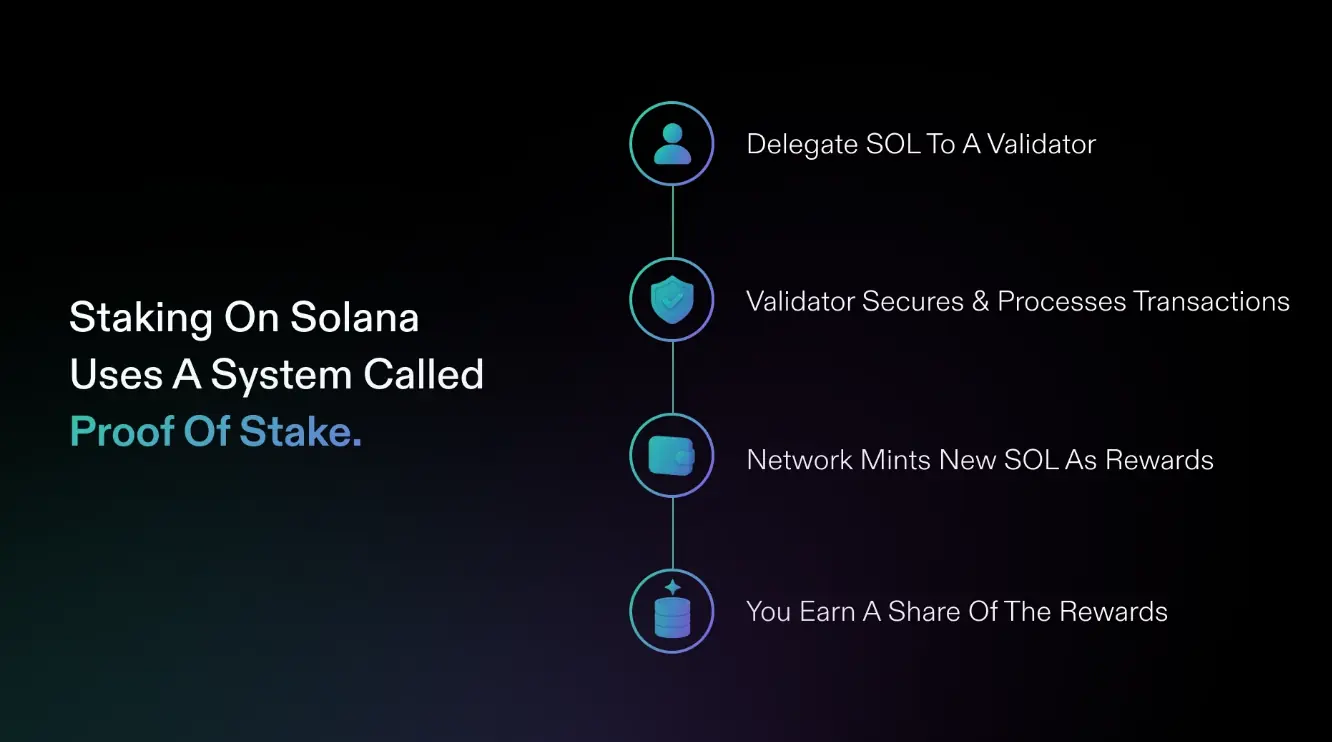
Solana native staking explained
Solana validators earn SOL through inflation when new coins are issued, by collecting priority fees when users pay extra to have their transactions land first, and via MEV rewards (Maximal Extractable Value) when users tip validators to include transaction bundles.
To earn staking rewards, validators must vote correctly on blocks that become part of the chain. Validators who fail to vote on time or experience downtime may not earn enough SOL for their stakers. That’s why it’s important to stake your coins with reputable validators that avoid such issues. Some of the best places to stake SOL include Jito, Jupiter, Marinade, Helius, and even exchange validators like Kraken and Coinbase.
Rewards and unstaking
As of October 1, 2026, native SOL staking rewards range from 4.7% to 5.23%, depending on the validator’s performance and on-chain activity. This means that staking 100 SOL can earn up to 5.23 SOL in staking rewards over 12 months at a rate of 5.23%. Earned yield is paid every Solana epoch, which is about two days, and accrues in your staking account.
When you no longer wish to stake, you can unstake. Typically, it takes two days for your funds to be unlocked and ready to use again. Because the SOL you staked is yours, it doesn’t depend on liquidity. It simply returns to your wallet account after one Solana epoch has ended.
Risks of native SOL staking
As with any Solana passive income option, there are risks to staking SOL natively. The main risk is SOL price volatility. If you buy SOL at $150 and it drops to $50, you lose 66% on paper. As long as you don’t sell and SOL’s price recovers, you will ultimately end up with more SOL in your wallet, and it will be worth more than when you started.
Additionally, there’s validator risk if you stake with a validator that fails to stay online and vote on time. You won’t lose your staked SOL, but you also won’t earn yield. Fortunately, this isn’t an issue with the top Solana validators.
Verdict
Solana investors who plan to hold their SOL coins long-term will find that staking natively is the best way to earn passive income. With around 4.7% APY accrued every Solana epoch and no risk of losing your staked coins, it offers a stable yield.
The main risk with this option is the price volatility of your SOL, which could lose value during typical bear markets.
2. Liquid staking: Best for keeping your SOL liquid
Liquid staking is similar to native SOL staking, with one major difference: you can continue using your coins on DeFi platforms while they are staked. This is an excellent option for those who want to keep their SOL liquid and earn passive yield at the same time.
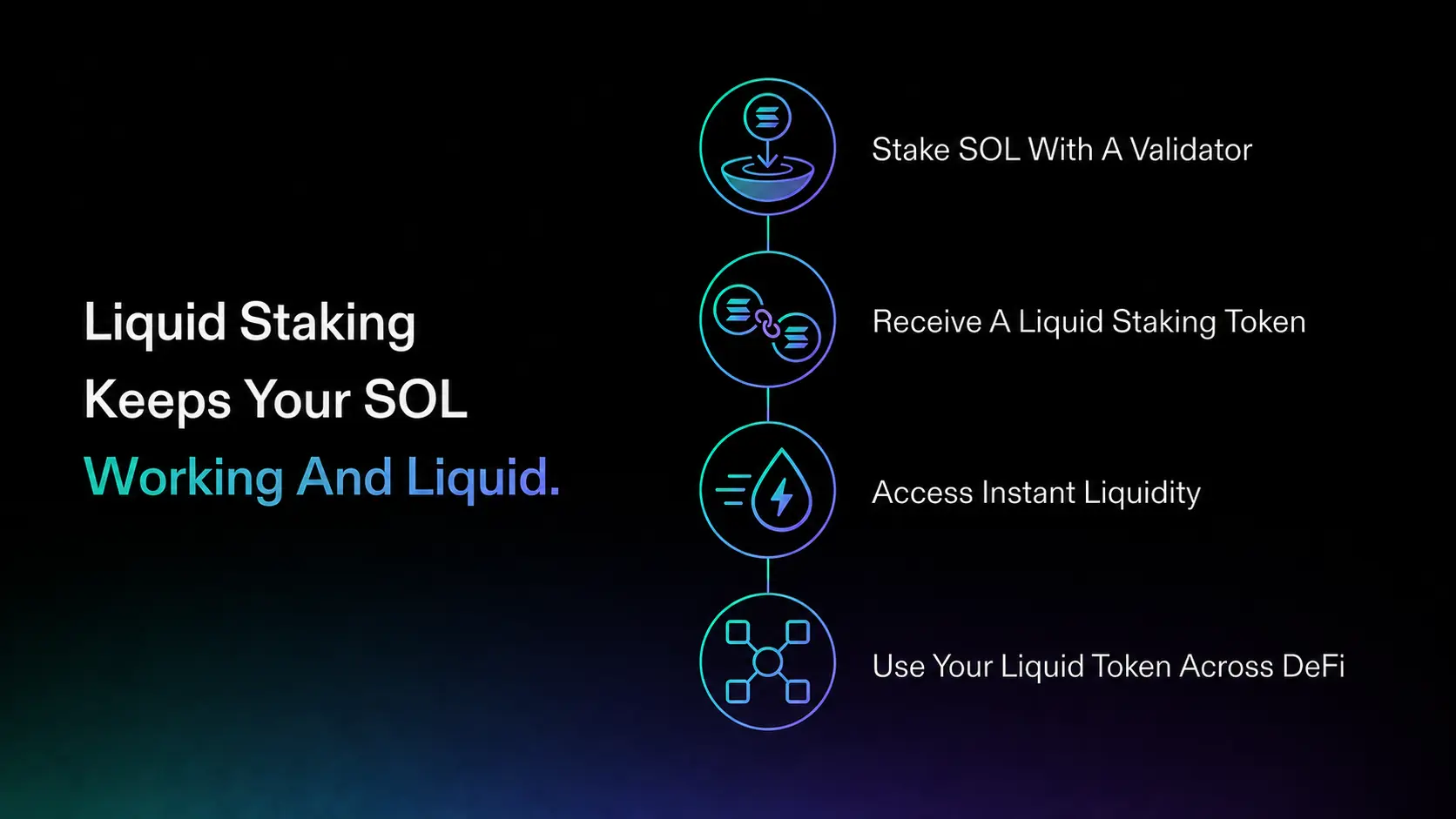
Solana liquid staking explained
Some Solana validators allow you to stake your SOL coins with them natively and receive liquid staking tokens (LSTs) in return. As with native staking, the yield earned by the validator is passed to the LST holder.
Because the staking yield is automatically reinvested in the staking pool, the LST always has a higher value than SOL. For example, if you want to exchange your jupSOL for SOL, 1 jupSOL is worth 1.19 SOL now, but in two years it could be 1.40 as the value accrual grows. So the LST formula would be:
1 LST = 1 SOL + interest accrued over time
Liquid staking tokens have a different name, depending on who issued them: JitoSOL, jupSOL, hSOL, mSOL, etc.
Rewards and unstaking
As mentioned before, the APY you earn by holding LSTs is nearly the same as staking SOL natively. The main benefit of holding LSTs is liquidity, which lets you use them across DeFi apps like Kamino and Jupiter.
If you need instant cash but don’t want to sell your LST, simply provide it as collateral on Kamino or Jupiter Lend to borrow stablecoins against it.
Those willing to take on higher risk could use looping strategies with multiply. These are automated strategies that borrow SOL against your LST, use the funds to buy more LST, and then borrow more SOL, repeating the process. Yields on such strategies could reach up to 20% APY with various token incentives, which certainly seems more enticing than the 5% staking yield. However, it comes with added risk, and the extra yield may not be worth it for every investor.
Unlike native staking, which requires two days for the Solana epoch to end before you can claim your SOL, with liquid staking you simply swap it to SOL or any other token on the Jupiter DEX or any other DEX on Solana, and you’ve exited your position instantly.
Risks of liquid SOL staking
While liquid staking is highly secure, with the smart contract audited by multiple security firms, there is still a risk it could be exploited. This risk comes in addition to SOL price volatility, which is inherent in SOL staking.
Verdict
Investors looking to use their staked SOL in DeFi while still earning yield will find liquid staking an excellent Solana passive-income option. Passive LST yield is reinvested within the token, giving it a higher nominal value than SOL.
As with native staking, SOL price volatility is the main risk, with a smaller risk of a smart contract exploit.
3. Holding JLP: Best for earning Jupiter Perps fees
As the name suggests, JLP (Jupiter Liquidity Provider) is the liquidity-providing token for Jupiter Perps. It represents a basket of SOL, ETH, wBTC, and stablecoins and serves as the counterparty to traders on Jupiter’s perpetual futures platform. JLP token holders earn 75% of the Jupiter Perps fees, which are automatically reflected in the token’s price.
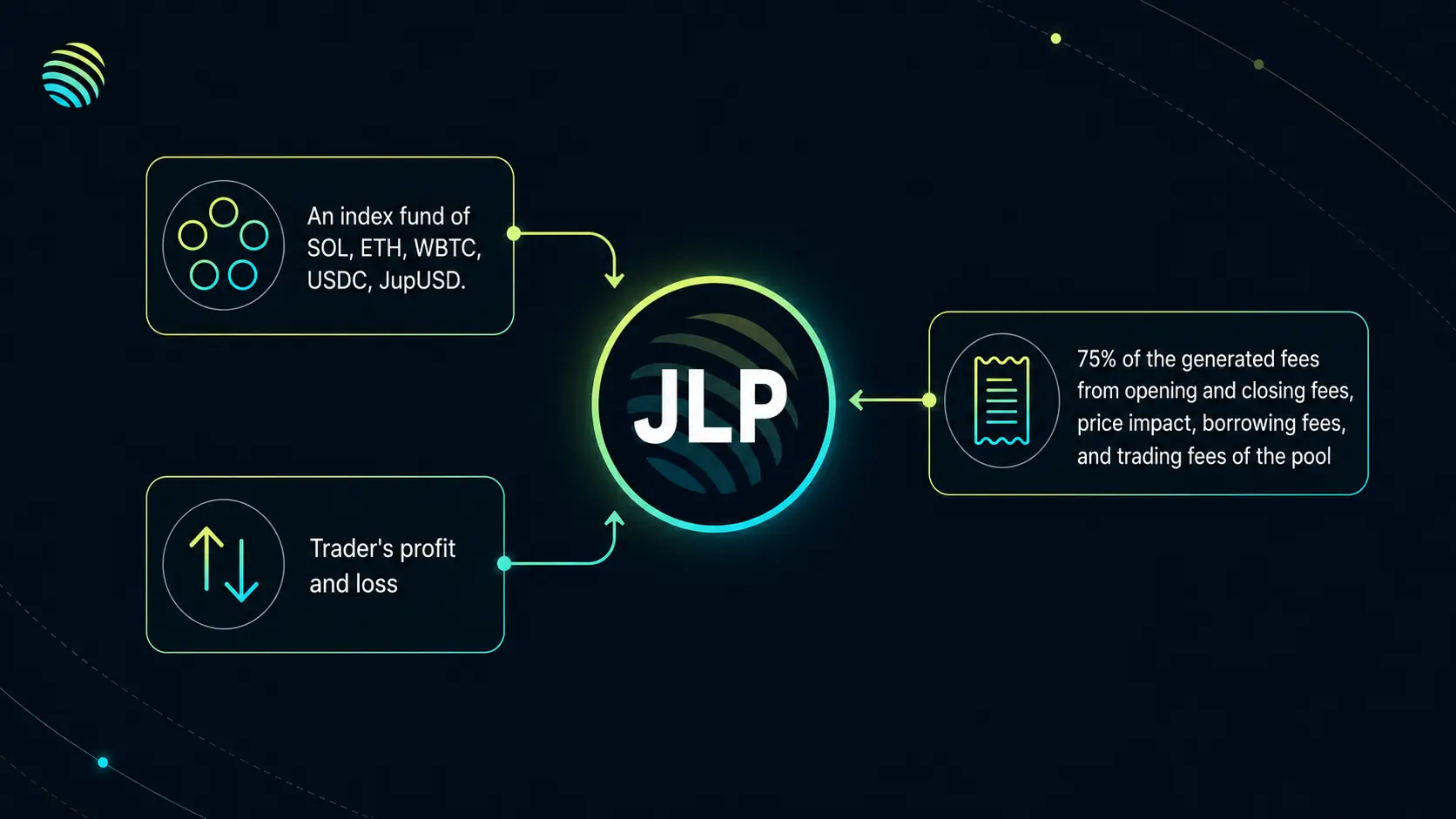
JLP explained
Jupiter Perps is the strongest Jupiter product and generates the most revenue, according to DefiLlama. From Q1 2025 to Q3 2026, Jupiter Perps generated over $130 million in fee revenue. These figures are significant in the crypto space, given that many projects are unprofitable.
The JLP token itself has two main functions:
-
Provides liquidity and serves as the counterparty to Jupiter Perps traders. When traders lose money, the losses benefit the JLP pool, and vice versa.
-
Receives 75% of the fees generated by the platform.
There is no staking with JLP, so you simply buy and hold the token. The more Jupiter Perps generate fees, the higher the value of JLP.
Holding JLP can be considered a passive income strategy because Perps fees compound automatically without active position management. However, JLP isn’t a low-volatility income product.
Its price moves with the underlying cryptoassets and with the profits or losses generated by Jupiter Perps traders. This makes it a solid product to accumulate during bear markets, when the prices of BTC, SOL, and ETH are low and perpetual futures activity is low, resulting in an attractive JLP price.
As of July 2026, JLP had over $800 million in total value locked, with 46% of that amount being in SOL.
JLP rewards
The “rewards” of holding JLP are twofold: one is JLP price appreciation driven by the appreciation of the underlying assets in the pool (SOL, ETH, and BTC); another is JLP’s variable percentage yield, calculated from fees generated by Jupiter Perps and updated every seven days.
This means you don’t receive extra tokens; the yield is reflected in the JLP price.
Can I sell JLP whenever I want?
Yes. JLP is just another token on the Solana blockchain, so you can open Jupiter Swap and sell your JLP for any other token or stablecoin to close the position.
Risks of JLP
The price of JLP directly depends on the prices of SOL, ETH, and BTC. If these assets drop in value, the price of JLP will follow. Additionally, JLP takes 75% of the Jupiter Perps fees. If this product earns less, the JLP price will reflect that with a lower percentage yield.
Another type of risk is smart contract and platform risk, which could occur regardless of how thoroughly Jupiter’s products are audited.
Verdict
JLP is a passive-income strategy that automatically compounds Jupiter Perps fee income without borrowing or liquidation risk, making it a solid option for investors who want to diversify their crypto exposure.
JLP captures 75% of the Jupiter Perps fees, which makes it a strong and profitable product. Additionally, JLP’s price is affected by SOL, ETH, and BTC prices, as they are held within the Perps liquidity pool.
4. JUICED: Best liquid yield-bearing stablecoin
Similar to SOL liquid staking tokens, Jupiter has introduced a liquid staking stablecoin called JUICED. Currently, JUICED offers the highest stablecoin yield for passive income simply by holding it in your wallet.
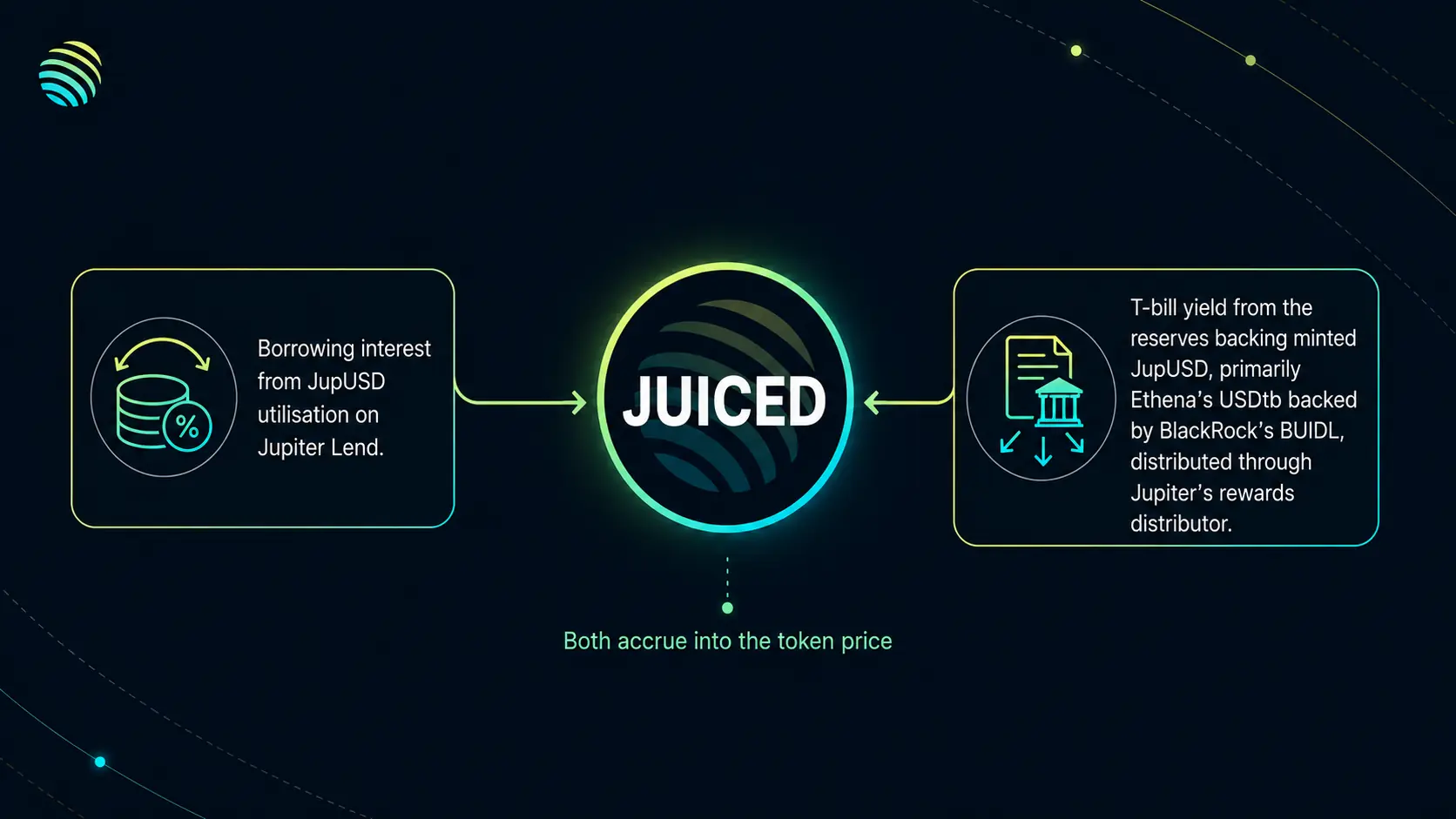
JUICED explained
Jupiter has its own stablecoin, JupUSD, backed 90% by USDtb (Ethena’s treasury-backed stablecoin collateralized by BlackRock’s BUIDL tokenized US Treasury fund) and 10% by USDC held in decentralized pools to ensure instant redemptions and smooth trading.
When users deposit JupUSD into Jupiter Earn to earn passive APY, they receive JUICED tokens in return that represent the locked JupUSD. This means there’s no leverage and no liquidation risk. Additionally, you can supply JUICED as collateral and borrow against it while still earning interest on your holdings.
Rewards
JUICED earns from two sources:
-
Borrowing interest. Users who borrow JupUSD through Jupiter Lend pay interest.
-
Reserve yield. The assets backing JupUSD generate US Treasury-bill income, which is distributed to JUICED holders.
Other stablecoins like USDT keep their Treasury yield as revenue, while USDC’s Circle shares its revenue with Coinbase. Because JupUSD distributes its reserve yield to holders, it can offer a much higher yield than USDT and USDC.
JUICED holders don’t receive additional JUICED tokens as rewards. Instead, each JUICED token increases in value when redeemed for JupUSD or other stablecoins.
For example:
-
You deposit $1,000 in JupUSD.
-
You receive around 1,000 JUICED.
-
If the strategy earns more than 5% within a year, your JUICED could be redeemed for $1,050 JupUSD.
In essence, the number of your JUICED tokens in your wallet remains the same, but their value has increased based on the APY.
JUICED holders can boost the standard yield with Jupiter’s JUICED/USDT strategy. However, the strategy uses 9x leverage and can increase the JUICED yield from around 5.0% to 4.92%, which may not justify the risk, even if it is small.
Can I sell my JUICED tokens?
Yes. Like any other token on Solana, you can sell your JUICED whenever you want for stablecoins, SOL, or any other token you wish.
Risks of holding JUICED
While the strategy and backing of JUICED are straightforward and the risk of JupUSD depegging is minimal, there are still risks. Even stablecoins like USDC have depegged in the past, even shortly.
Moreover, JUICED relies on Ethena’s USDtb, BlackRock BUIDL, and custody arrangements. If any of them fail, it could affect the JupUSD price.
As with any other blockchain protocol, there are smart contract risks. Frequent audits reduce the risk, but exploits could still occur.
Verdict
JUICED is the best stablecoin option on Solana for passive income right now because of its high yield, a secure protocol, and simplicity. There’s no leverage, so risk is minimal, making it an ideal option for investors or traders who want to earn yield on their stablecoin capital while waiting for the right moment to deploy it.
5. Huma Classic PST: Best high-yield real-world strategy
Huma Classic differs from most yield-bearing strategies on Solana because it’s tokenized private credit, not ordinary stablecoin lending like those on Jupiter or Kamino. As a result, its yield is potentially more durable than temporary incentives, which are common in DeFi. However, this product carries slightly higher risk than other stablecoin lending strategies.
Huma Classic explained
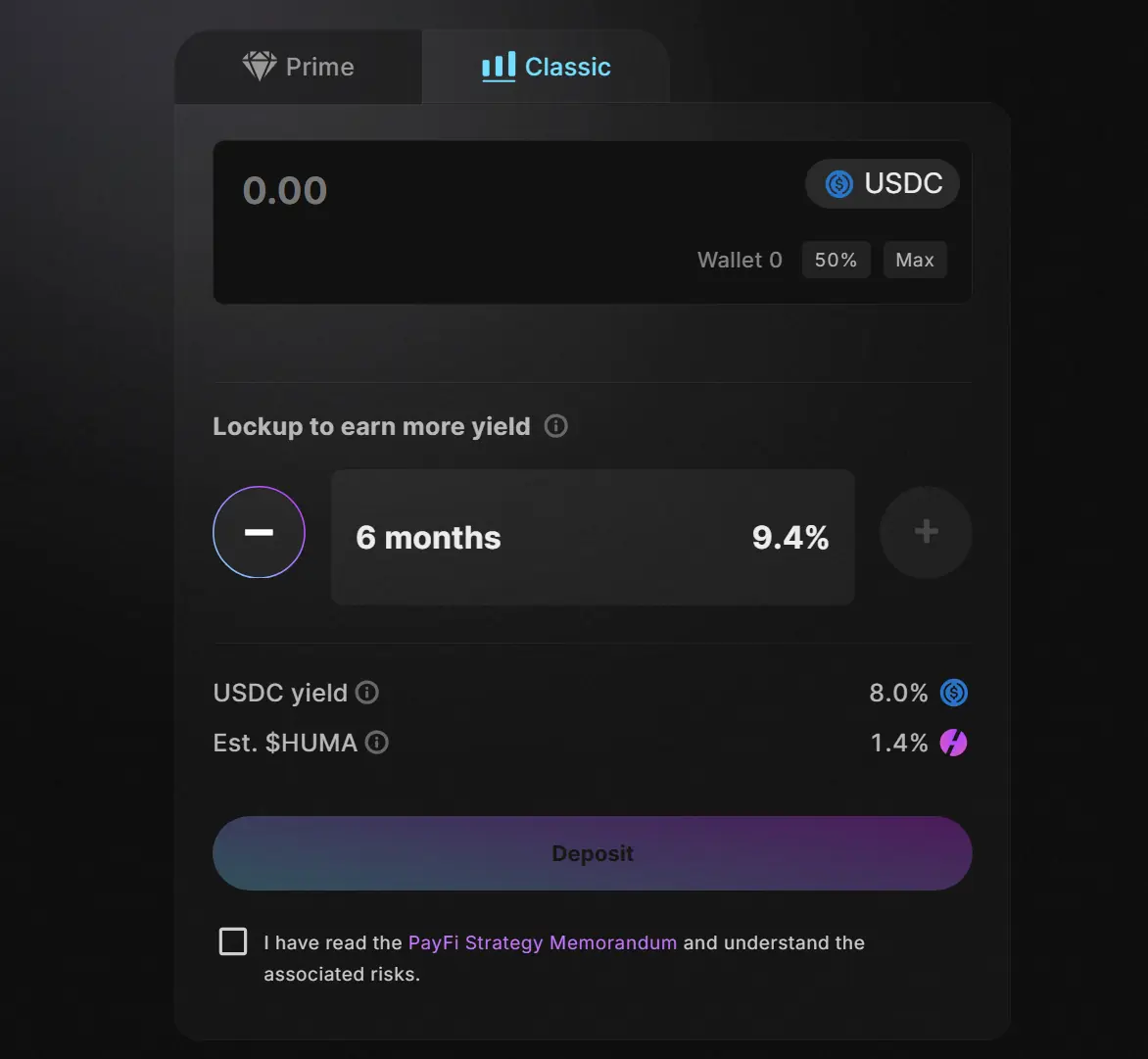
Huma Classic allows investors to earn USDC yield and HUMA tokens by providing short-term financing to businesses that process real-world payments.
The process is simple: Investors deposit USDC on Huma’s site and receive PST (PayFi Strategy Token), a yield-bearing Solana token that represents their share of Huma’s financing strategy. Huma holds 85% of the assets in its pool for PayFi strategies and 15% in market-neutral liquid assets to ensure liquidity for redemptions.
Payment institutions use Huma’s liquidity to settle transactions without holding large amounts of capital across multiple markets. Businesses typically pay between six and 10 basis points per day and repay the financing within one to five days, according to Huma.
Rewards
Huma Classic currently offers an APY of 8% in USDC and 1.7% in HUMA tokens, for a combined APY of around 9.7%, making it one of the most rewarding stablecoin yields on Solana. This yield comes with a six-month lock-up period.
Additionally, there’s a three-month lock-up period with a 9% APY (8% USDC and 1% HUMA), and a no-lock-up yield of 8.2% (8% USDC, 0.2% HUMA).
Investors can buy the PST token directly via Jupiter Swap and hold it to gain exposure to Huma Classic. This also works because Huma adds its payment-financing income to the Classic strategy, where the yield belongs to the token. The token itself should gradually increase in value. However, when investors buy PST directly, they forfeit the additional HUMA rewards tied to the wallet that makes the deposit in the Huma Finance app.
Can I exit whenever I want?
If you hold the PST token, you can swap it via Jupiter Swap or any other Solana DEX for any other token you want.
However, if you deposit directly on the Huma Finance site, there may be a lock-up period. If you withdraw before the period expires, you forfeit your HUMA rewards. Additionally, redemption via the Huma site is processed on a first-come, first-served basis, and most are completed within a day, though in some cases it may take up to seven days.
There’s an instant withdrawal option, but it carries variable fees that depend on the liquidity level in the pool.
Risks of investing in Huma Classic PST
Huma has been audited by multiple security firms, including Spearbit, Halborn, and Certora. The company also follows security best practices, but risks remain, including smart contract, regulatory, liquidity, and credit risks.
Verdict
Huma Classic PST is one of the best passive income options on Solana, offering high stablecoin yield via real-world borrowing. Compared to options like JUICED, PST comes with slightly higher risk.
Which Solana passive-income option is best for you?
All five Solana passive-income options are solid, depending on investor goals. These options don’t use leverage, which significantly reduces risk.
| If you want… | Most suitable option |
|---|---|
| The simplest way to earn from SOL | Native staking |
| Staking yield while keeping SOL liquid | LST tokens like JitoSol, jupSOL, hSOL, bSOL, INF, etc. |
| To grab 75% of Jupiter Perps fee revenue and get broad exposure to SOL, ETH, and BTC | JLP |
| High stablecoin yield while keeping funds liquid | JUICED |
| Highest stablecoin yield with credit risk | Huma Classic PST |
Strategies that did not make the top five
I evaluated several passive-income options on Solana for this article, and there were two promising candidates. Unfortunately, neither made the cut.
-
Steakhouse USDG high-yield strategy on Kamino offers the highest stablecoin yield, over 9%. However, the yield was subsidized for three months. For those looking for a quick boost in yield, it would be a decent strategy to consider. However, this isn’t passive, as you’d have to monitor when the incentives stop and the yield drops to ~4%.
-
Jupiter Ethena x Bitwise USDG Loop can get up to 20% APY with a USDe and USDG loop. However, capacity on July 24, 2026 was full. If capacity opens, it could be worth considering, but there’s no information on when or if that will happen.
Risk of earning passive income on Solana
While Solana is a secure blockchain and all the protocols listed here have undergone rigorous audits, there are still risks to consider before committing your funds.
The first risk is smart contract exploits. In April 2026, hackers drained over $290 million in crypto after exploiting a cross-chain bridge. That same month, $285 million was drained in a coordinated attack on Solana’s perps exchange, Drift Protocol. All the protocols listed as the top five best passive income options on Solana have been audited by multiple security firms and, over their years of operation, haven’t suffered any exploits. Despite that, there is always a risk that something could happen.
Price volatility is another risk. Assets like SOL and JLP aren’t stable. They fluctuate during the various phases of the bull and bear cycles. The passive income from these assets is paid in the asset itself.
Stablecoins like JUICED carry depeg risk. Even though JUICED is backed by Ethena’s treasury-backed stablecoin, USDtb, which is collateralized by BlackRock’s BUIDL tokenized US Treasury fund, there are no guarantees it will never depeg. However, JUICED is not a leveraged position, so as long as the stablecoin returns to peg, there shouldn’t be any issues.
Huma Classic PST carries credit and liquidity risks. If someone fails to pay off their debt or there isn’t enough liquidity for everyone to cash out, this could be a problem. However, this is a minor risk right now.
Finally, investors themselves can have their wallets hacked and funds drained. It’s important that you never keep your wallet’s seed phrase (private keys) on your computer or take photos of them. Write them on a piece of paper and keep them somewhere safe. As an extra precaution, you can get a hardware wallet, which is a USB-type device that stores the seed phrase offline and encrypted, making it much harder for hackers to steal your funds.
Conclusion
Native SOL staking remains the best default passive-income option on Solana for long-term holders because it offers a straightforward yield without introducing DeFi lending or protocol risk.
Liquid staking is more flexible, while JUICED and Huma Classic serve investors who prefer dollar-denominated income and are willing to accept additional risk. JLP is a solid option for those seeking passive income from a protocol that captures 75% of Jupiter Perps’ fee income.
As with any crypto investment, never invest more than you can afford to lose.
This article is for informational purposes only and is not financial advice.
Frequently asked questions
What is the safest way to earn passive income with SOL?
The safest way to earn passive income with SOL is native staking with reputable validators such as Jupiter, Phantom, Helius, Kraken, and Coinbase.
How much can you earn by staking SOL?
You can earn around 4.7% as of October 1, 2026.
Is Solana staking risk-free?
No. The main risk with Solana native staking is that a validator may not earn rewards due to downtime or failure to vote.
Can you lose SOL when staking?
No. Your funds are locked with the validator, and you can withdraw whenever you want. However, it takes one Solana epoch (about two days) for your funds to return to your wallet.
Can you earn two yields by depositing JitoSOL into Kamino?
No. The yield shown on the Kamino dashboard includes JitoSOL’s native staking yield.
Is JUICED a stablecoin?
No, JUICED is a liquid staking token for the JupUSD stablecoin. Its value changes over time based on the interest it accrues.
Are Solana passive-income yields guaranteed?
No, Solana passive-income yields are variable.
Do you need SOL to pay transaction fees?
Yes! Keep at least 0.2 SOL in your wallet to ensure smooth transaction execution.