
Collector Crypt is the latest craze in the NFT space, but is it worth it? At first glance, the Collector Crypt gacha appears to have a positive expected value, especially as advertised on the site. However, independent on-chain analyses found that most wallets did not finish ahead in realized cash, despite the platform generating substantial revenue.
This Collector Crypt review explains how the gacha packs work, what “positive EV” actually measures, how much spending has been returned through instant buybacks, and whether the platform’s growth strengthens the investment case for CARDS. It also includes my first-hand Jupiter Gacha test, in which I spent $225 across nine $25 packs and received $203.15 through instant buybacks.
Updated August 29, 2026: This review now includes my first-hand results from opening nine $25 Jupiter Gacha packs and accepting the instant buyback for every pull.
Quick verdict: Are Collector Crypt packs worth it?
Collector Crypt packs may be worth opening occasionally by collectors who value the entertainment and are comfortable keeping tokenized cards or trading them. However, they are not a reliable investment strategy.
The advertised EV is typically based on insured card values, while instant buybacks return only a percentage of that value. Independent on-chain research shows that realized cash returns are lower than the headline EV suggests.
| Key finding | What it means |
|---|---|
| Advertised EV can exceed 100% | It is based on insured card values, not guaranteed cash returns |
| A $50 pack may have only $47.06 of expected instant-buyback value | That equals approximately 94.1% immediately realizable RTP |
| Major analyses found 91.85%–94.2% buyback RTP | Around 5.8%–8.2% of spending was not returned through identifiable buybacks |
| Only 22% of analyzed wallets finished ahead in cash | Most wallets did not realize a cash profit during Bitquery’s study period |
| The median wallet result was approximately −$50 | A few larger winners raised the average above the typical outcome |
| 714 wallets generated roughly 88% of analyzed spending | Collector Crypt’s activity is heavily concentrated among high-volume users |
| My nine-pack Jupiter Gacha test returned 90.29% through buybacks | I spent $225 and received $203.15, this is a small first-hand sample |
| CARDS is not equity in Collector Crypt | Token holders do not automatically receive the company’s revenue or profits |
Buyback RTP (Return to Player) excludes cards that users kept, redeemed, or sold elsewhere. Figures also vary by source because each analysis covers a different period and dataset. Sources and methodologies are detailed below.
What is Collector Crypt?
Collector Crypt is a Solana-based platform that represents physically vaulted and graded trading cards as redeemable digital tokens (NFTs). These include mostly Pokémon cards, as well as anime pop culture and sports cards.
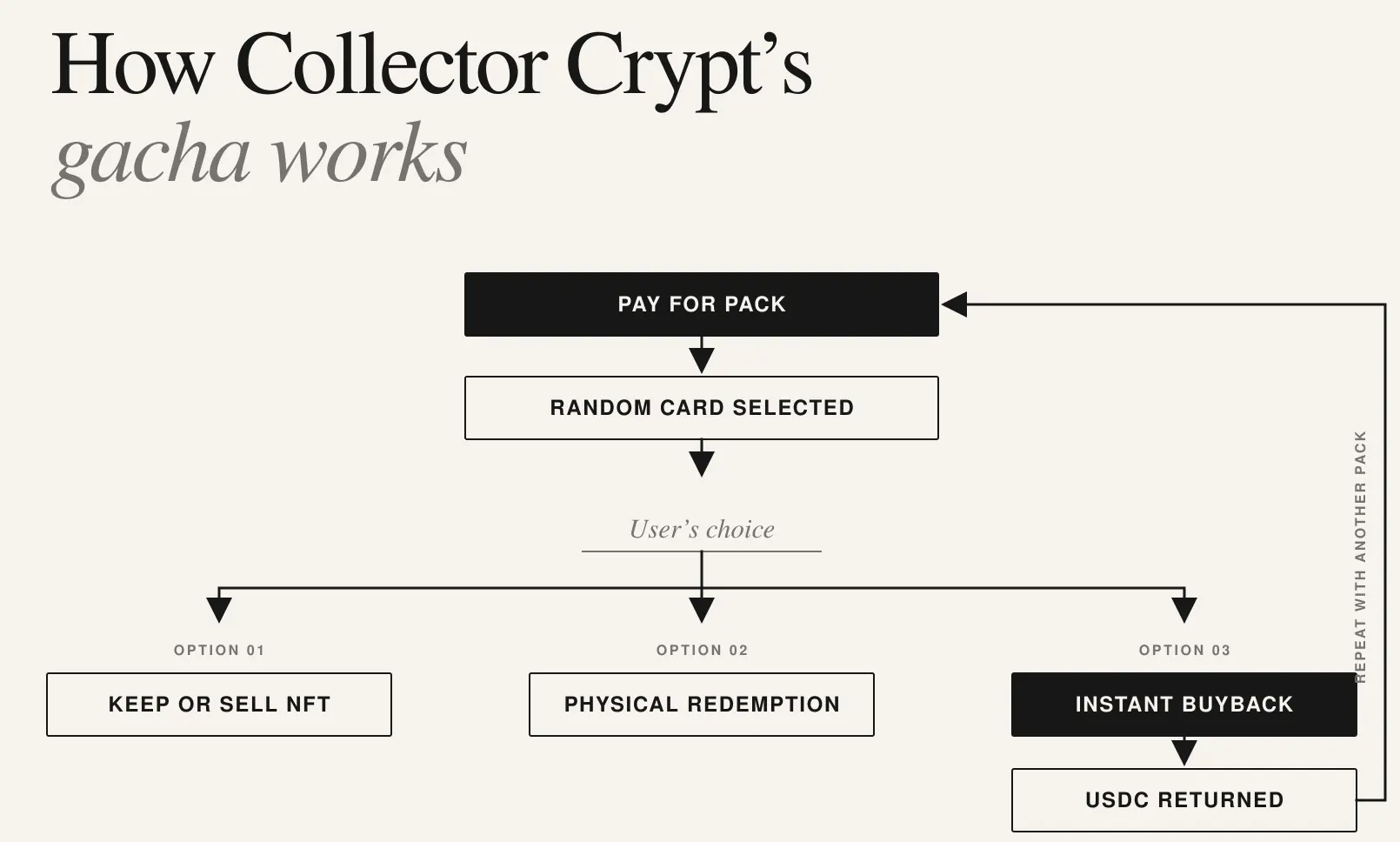
The platform features a gacha machine, a gamified, randomized pack-opening system that lets users draw cards backed by actual vaulted assets. Users can redeem their NFTs for the real cards if they want to, or sell them on the NFT marketplace.
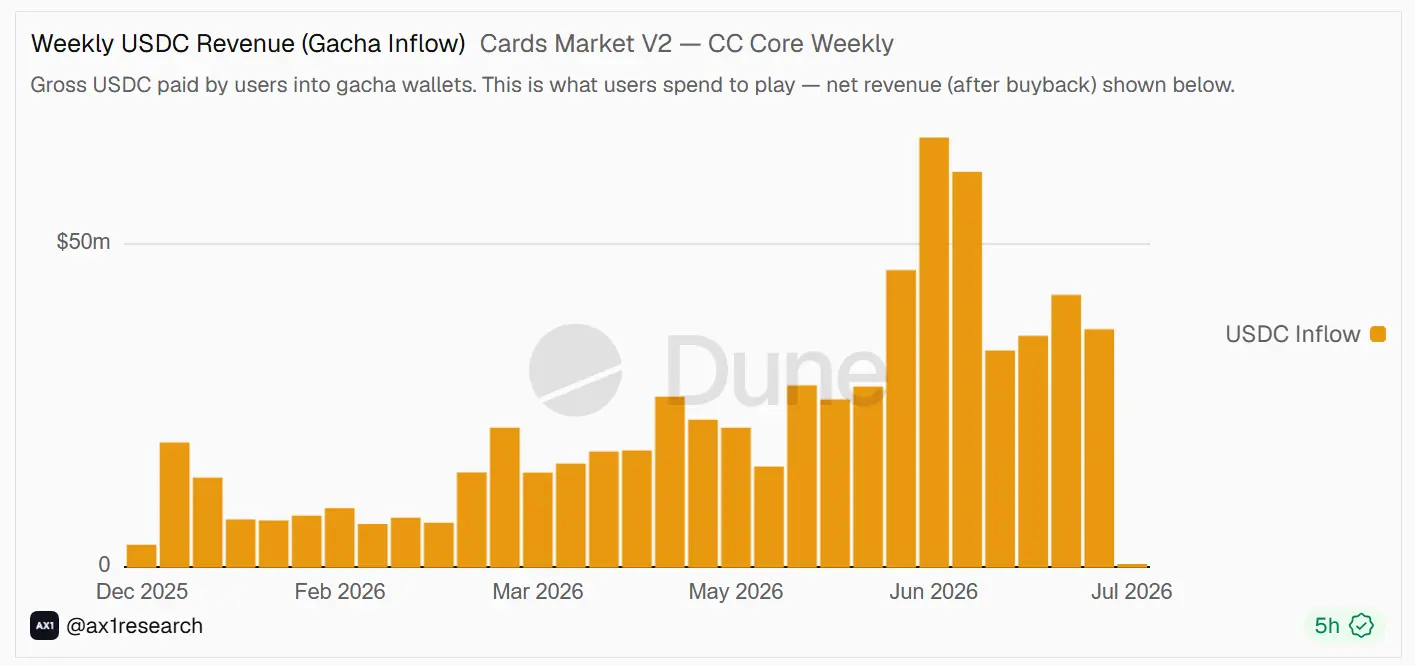
On-chain data show that users have already spent nearly $700 million on card purchases from December 2025 to July 2026. Weekly spending rose from below $10 million to a peak of over $60 million in June 2026.
A portion of the platform’s revenue is used to buy more physical cards, creating a treasury-backed value model.
Jupiter, the largest swap aggregator and a DEX on Solana, launched Jupiter Gacha in partnership with Collector Crypt, bringing the product to millions of users. Within the first five days, Jupiter Gacha saw $9 million in packs opened.
How do Collector Crypt Gacha packs work?
The gacha is a gamified machine that opens randomized packs containing tokenized versions of real cards stored in secure vaults.
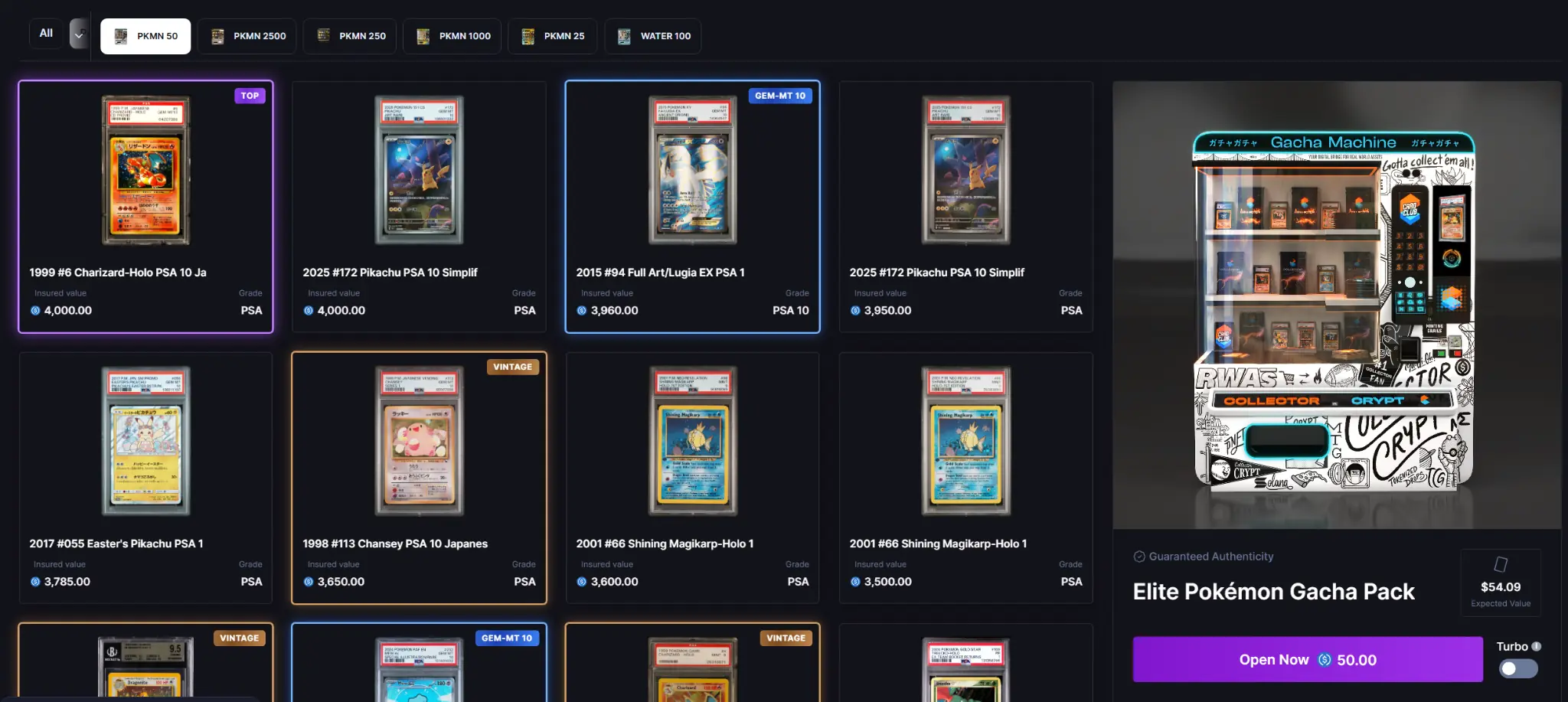
Users select the pack type they want to open based on price ($25, $50, $100, $250, $1,000, $2,500). Regardless of the pack type chosen, the Collector Crypt page will display:
-
Expected value, a metric that’s always above the purchase price.
-
Instant buyback offer, a percentage of the card’s insured value that varies by pack.
-
Statistics showing the odds of receiving common, uncommon, rare, or epic cards.
Collector Crypt has made it seamless to buy these cards with bank cards, crypto, Cash App, Google Pay, or Apple Pay.
One useful feature is instant buybacks for drawn cards, allowing users to sell their cards as soon as they are opened without liquidity concerns. Granted, instant buybacks come at a lower price than what users can get by holding their cards or selling them on the marketplace. But at least they guarantee instant liquidity, even at a potential loss.
There’s also a turbo switch that instantly sells common cards, enabling users to “hunt for the grail at maximum speed”.
Users can list their cards on the marketplace to sell them for a higher price than the buyback price, or redeem them for a physical card, which will be delivered to the address they provide.
When buying the cards, users see the “expected value,” which is always higher than the pack’s price. For example, a pack that costs $50 can have a positive expected value of $54.13.
What does positive expected value mean?
A positive expected value means that, on average across multiple pack openings, the value of the cards a user receives exceeds the amount spent.
For example, if a pack costs $50 and the stated expected value is $54.13, the pack’s expected net insured value is:
$54.13 – $50.00 = $4.13
However, this doesn’t mean you should expect to profit $4.13 from every $50 pack. Sometimes you could receive a card worth $20, other times a card worth $30, and maybe a rare card worth $500. The expected value is just a theoretical average, calculated as:
EV=∑(outcome probability×outcome value)
More importantly, a positive insured-value EV doesn’t mean a positive cash EV. A user may need to keep, redeem, or manually sell the card on the marketplace to capture its assigned value.
So a $50 pack could have:
| Measurement | Amount |
|---|---|
| Expected insured value | $54.13 |
| Expected net insured value | $4.13 |
| Expected instant-buyback value | Approximately $46 |
| Immediately realizable cash return | Approximately 92% |
| Expected net cash result | Approximately –$4.00 |
The instant buyback value is lower because it represents 85% of the expected insured value:
$54.13 x 85% ≈ $46.00
As a result, each pack can have a positive expected value based on insured card prices yet a negative expected value when measured by immediately realizable cash (the Collector Crypt 85% instant buyback option).
What the on-chain data shows
While at first glance it seems every pack is worth more than it costs, on-chain data paints a different picture.
Collector Crypt’s realized buyback RTP
| Source | Observation period | User spending | USDC returned to users through card buybacks* | Buyback-to-sales ratio |
|---|---|---|---|---|
| Bitquery | December 2025 – July 2026 | $622.6 million | $586.6 million | 94.2% |
| DefiLlama | June 2025 – July 2026 | $879.4 million | $807.7 million | 91.85% |
* Retained cards by users are excluded from realized-cash calculations.
Did most wallets make money?
Approximately 22% of the analyzed wallets received more cash than they spent, according to Bitquery’s realized-cash analysis, while the median wallet result was approximately –$50.
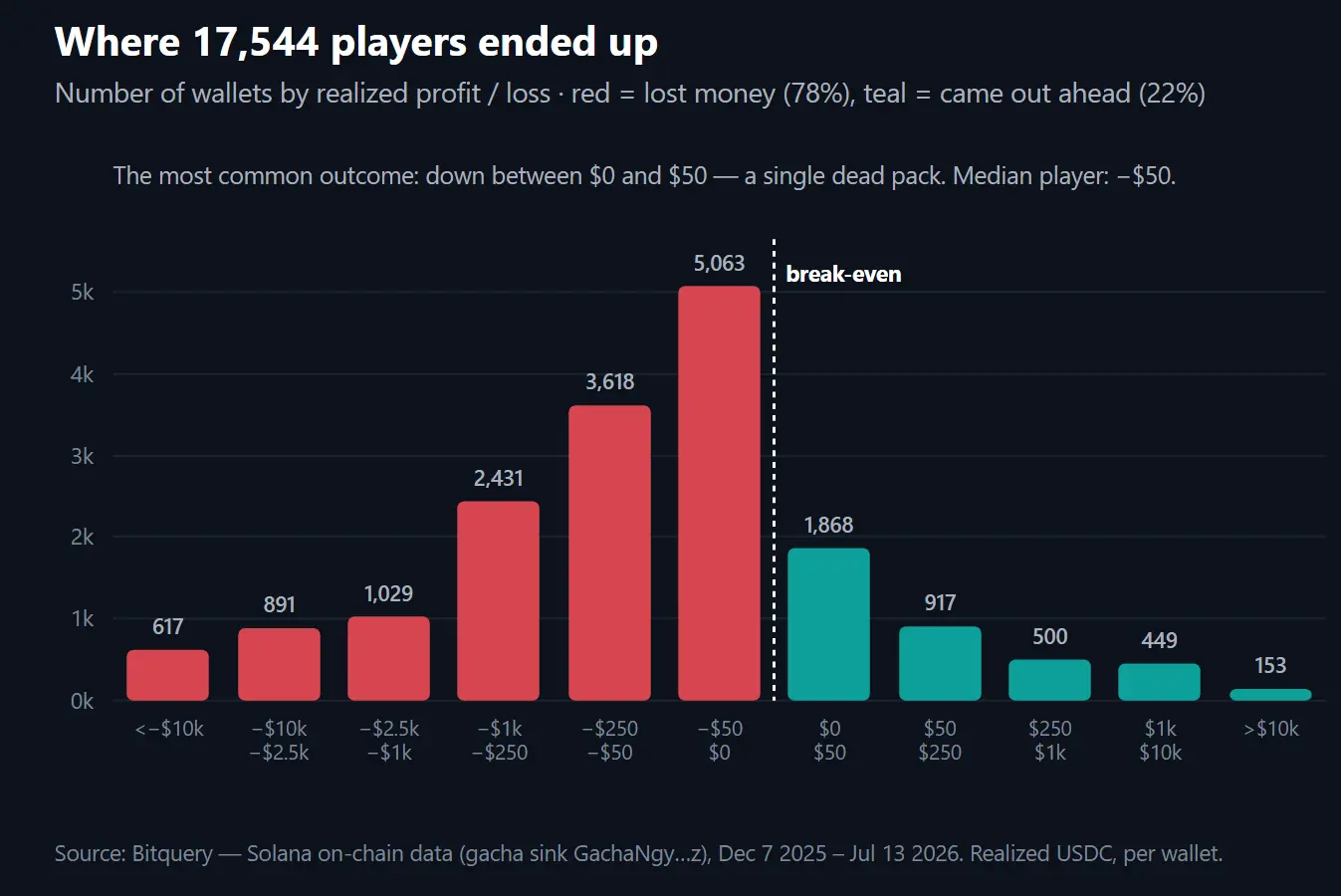
Probably the most discouraging finding was that those who spent more had the worst pulls. 714 wallets spent over $100,000 on pack openings, with an average loss of $41,302 per wallet. These are the biggest spenders, accounting for $550 million of all packs opened.
Those who spent under $50 on one or two tries got better results 29% of the time and almost broke even on average.
Although the original appeal and the advertisement evoke card-collecting nostalgia, Bitquery’s analysis showed that 68% of all pulls were instantly sold to Collector Crypt’s buyback mechanism, revealing that profit-seeking is the prevailing goal.
This means the headline gacha volume is not fresh capital but rather recycled cash from users who instantly sell their cards and use the proceeds to open another pack. In the end, the results are clear: one in every five players got more money than they spent.
One of the best takes in this analysis is that “the jackpots are real and visible and the losses are quiet and private”.
My Jupiter Gacha results: nine $25 packs
To compare insured value with an immediately realizable cash return, I opened nine $25 Jupiter Gacha packs in August 2026 and accepted the instant USDC buyback for every pull. This was a small first-hand test: I purchased and opened all nine packs, then sold every pulled card back.
| Metric | Result |
|---|---|
| Packs opened | 9 |
| Cost per pack | $25 |
| Total spent | $225 |
| Total received through instant buybacks | $203.15 |
| Realized cash result | −$21.85 |
| Realized buyback RTP | 90.29% |
| Implied combined insured value at an 85% buyback rate | $239 |
| Insured value minus pack cost | +$14 |
| Buybacks worth more than the $25 pack price | 3 of 9 |
| Buybacks worth less than the $25 pack price | 6 of 9 |
| Median buyback | $20.40 |
The realized buyback calculation is:
$203.15 ÷ $225 × 100 = 90.29% RTP
At the 85% buyback rate applied to these packs, the nine offers imply a combined insured value of $239. The cards’ insured values were therefore 6.22% higher than the total pack cost, but converting every pull immediately to USDC produced a realized loss of $21.85, or 9.71%.
My 90.29% result was slightly below the 91.85%–94.2% realized buyback RTP in the larger analyses above. With only nine packs, however, this result is too small to interpret as evidence that the platform-wide return has changed.
This test does not establish Jupiter Gacha’s long-term expected return, validate its published odds, or predict another user’s results. It demonstrates a narrower but important point: positive insured value does not necessarily mean immediate cash profit. In this nine-pack sample, accepting every instant buyback returned approximately 90 cents for each dollar spent.
Methodology: I recorded the $25 pack price and cross-checked the USDC buyback receipts against the corresponding Solana transactions. All nine cards were sold back; none were retained, shipped, or listed on the marketplace. Wallet addresses, transaction identifiers, individual receipts, and exact timestamps have been withheld to avoid publicly linking a personal wallet to my identity.
What can you do with a Collector Crypt card?
Once you open the pack, you have four options in Collector Crypt:
| Option | Benefit | Drawbacks |
|---|---|---|
| Keep the tokenized card | Retain exposure to the collectible | Price and liquidity risk |
| Instant buyback | Immediate USDC | Discount to insured value |
| Marketplace sale | Choose the asking price | Fee and uncertain sale time |
| Physical redemption | Receive the graded card | Shipping, VAT, and customs |
Collector Crypt lets you select multiple cards at once to list them on the marketplace in bulk, priced according to insured value. You can adjust the price if needed.
Buyback terms depend on where the pack was opened. On Jupiter Gacha, every pull has a guaranteed instant buyback of at least 85% of its insured value, paid in USDC and available for three days after the pull. The exact percentage varies by pack and may change over time. After the window expires, the card remains yours, but the guaranteed Jupiter buyback cannot be reopened. If you use Collector Crypt directly, confirm the rate and expiration displayed for the specific card before relying on the offer.
If you decide to keep your cards, there’s a bonus option: borrow against them on Jupiter’s Offerbook.
Here’s how it works:
- Visit Jupiter’s Offerbook.
- Select My Collaterals.
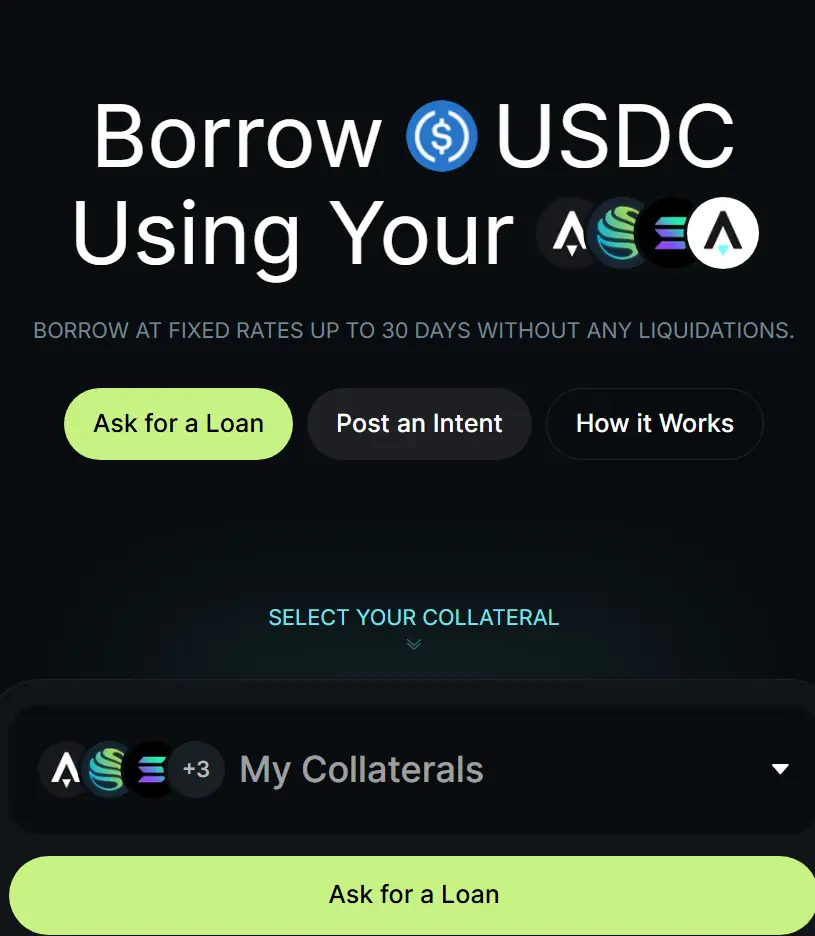
- Select Collectibles from the top options.
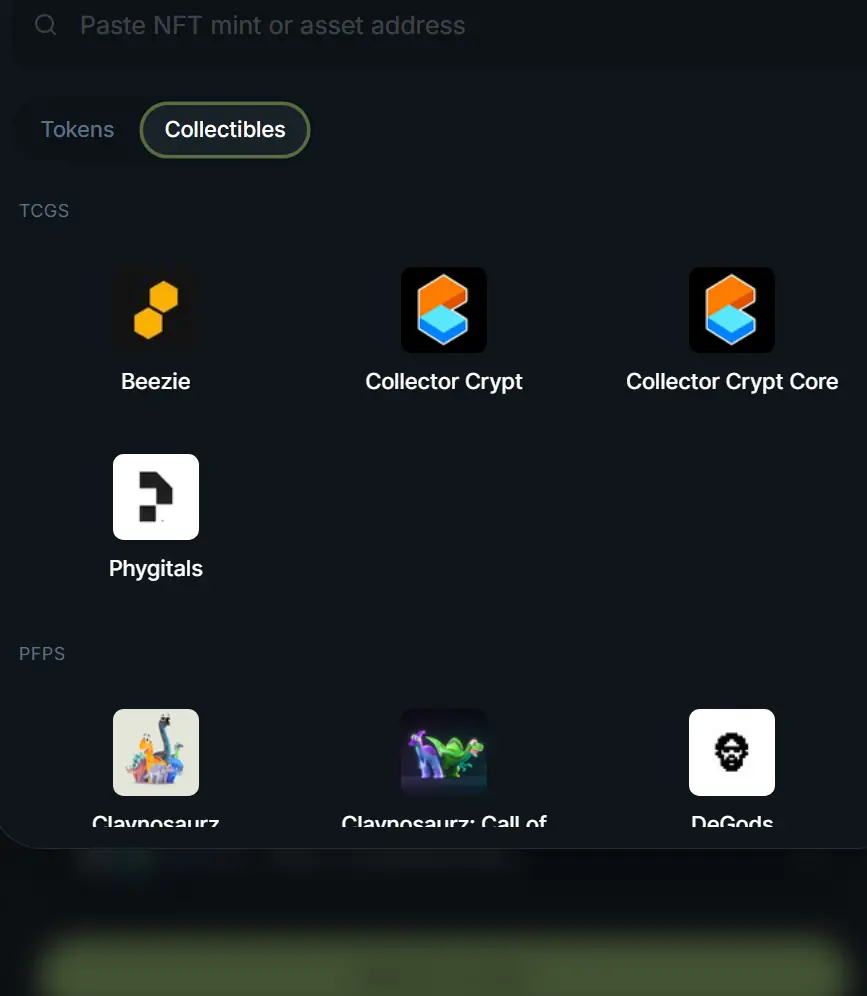
- Select Collector Crypt.
- Choose the card you wish to use as a collateral.
- Select Ask for a Loan.
- Fill out the details, such as APR, loan term, and the amount you’re requesting.
- Wait for lenders to accept your offer.
Is Collector Crypt fair?
Collector Crypt uses a Verifiable Random Function (VRF), which can be seen as a random-number generator that produces a cryptographic receipt. Users can then verify that the pack’s result was generated according to the published process rather than being secretly generated in the background by Collector Crypt.
Here’s how the process works:
-
When you buy a pack, your wallet signature creates an unpredictable input.
-
The VRF uses that input to generate a random result and a cryptographic proof.
-
One part of the result determines the card’s rarity (common, uncommon, rare, or epic).
-
Another part selects a card from the pool of eligible cards.
The result and additional information are recorded on the Solana blockchain. Users can enter the pack’s memo on Collector Crypt’s verification page to confirm that the result matches the on-chain records. If there’s any tampering, the verification would fail.
You can also verify by opening:
/verify-selection/YOUR_MEMO in your browser
Call GET /api/vrf/verify?memo=YOUR_MEMO
Collector Crypt risks
While opening Collector Crypt packs can be a fun and engaging way to try your luck at finding a rare card, there are risks to consider.
First, there are no guarantees that the cards you open will be worth more than you paid for your pack. In fact, there’s a negative cash EV with instant buybacks. Bitquery analyzed on-chain results and found that only 22% of wallets made more money than they spent on packs. That means four out of five wallets lost money. This was especially pronounced among those who repeatedly opened new packs.
The turbo pack-opening feature can encourage loss-chasing because it instantly sells common cards and recycles the USDC into new packs. If rapid reopening makes it harder to stick to a budget, turn off turbo and set a firm spending limit before opening packs.
Collector Crypt has further automated this loop through a separate tab called Yolo. Users enter the amount of USDC they want to spend, and the platform buys packs, opens them, and sells common cards automatically. This increases the risk of rapid loss-chasing.
On top of these risks, there are operational risks of custody, redemption, shipping, and smart contract exploits. Even though Collector Crypt ensures that everything goes smoothly, no one can guarantee the complete safety of your cards.
How does Collector Crypt make money?
Collector Crypt primarily earns revenue from the difference between pack payments and the amount returned to users through card buybacks. Once a card is bought back at a discount, it is rolled back into new pack openings, where users pay a higher price.
This allows the same physical card to support multiple pack openings. Similarly, USDC returned to users can be spent on another pack, meaning the initial deposit can generate recurring pack sales volume.
Based on DefiLlama data on July 30, 2026, Collector Crypt has processed approximately:
| Measurement | Amount |
|---|---|
| Gacha pack sales | $893.23 million |
| USDC returned to users through card buybacks | $820.42 million |
| Retained spread before inventory and operating cost | $72.81 million |
| Marketplace royalties | $2.79 million |
| DefiLlama-tracked protocol revenue | $75.60 million |
Over the full period tracked in DefiLlama’s income statement, approximately 91.85% of pack payments were returned to users through card buybacks.
Notably, the $72.81 million retained from gacha pack activity should not be described as profit, as DefiLlama doesn’t deduct potential material costs such as purchasing new cards, grading, insurance and custody, staff, technology, marketing, and all other expenses.
Marketplace royalties
Another revenue source for the company is fees collected when cards are traded through its marketplace. DefiLlama recorded about $2.79 million in cumulative marketplace royalties, which is substantially less than the retained spread from gacha activity, but it’s still strong.
Collector Crypt token CARDS: is it a good investment?
Collector Crypt launched its native token, CARDS, in August 2025, with a total supply of 2 billion. Reported circulating supply differed across trackers on July 31, 2026: DefiLlama displayed approximately 257.55 million, while Binance displayed approximately 415.9 million.
The token’s primary utility is earning gacha points each month based on how many CARDS tokens you hold in your wallet. The current rate is 0.4 points per CARDS token. These points can be used to open packs on the Collector Crypt platform, according to Collector Crypt’s Discord information.
| Pack | Points required | CARDS required to earn that many points each month |
|---|---|---|
| $50 Elite | 100,000 | 250,000 CARDS |
| $250 Legendary | 500,000 | 1.25 million CARDS |
| $1,000 Grail | 2 million | 5 million CARDS |
If you don’t have enough points for a pack, you can accrue them over multiple months because points don’t expire.
At $0.15 per CARDS token, you need to pay $37,500 to buy 250,000 CARDS tokens, which will accrue 100,000 points for a $50 Elite pack each month, assuming 0.4 points per 1 CARDS token remains unchanged.
However, if you use the platform, you can earn CARDS tokens every quarter based on several factors, including:
-
Gacha points
-
The value of cards you hold
-
The value of physical cards withdrawn
-
Use of Collector Crypt’s eBay sniper tool
-
The ownership of Card Club NFTs
The bull case for CARDS is that it is the native token of a real business with growing revenue, exceeding $70 million since its 2025 launch, according to DefiLlama. Pine Analytics’ first-quarter report also estimated $146.9 million in quarterly revenue and $8.6 million in gross profit, although its methodology differs from DefiLlama’s.
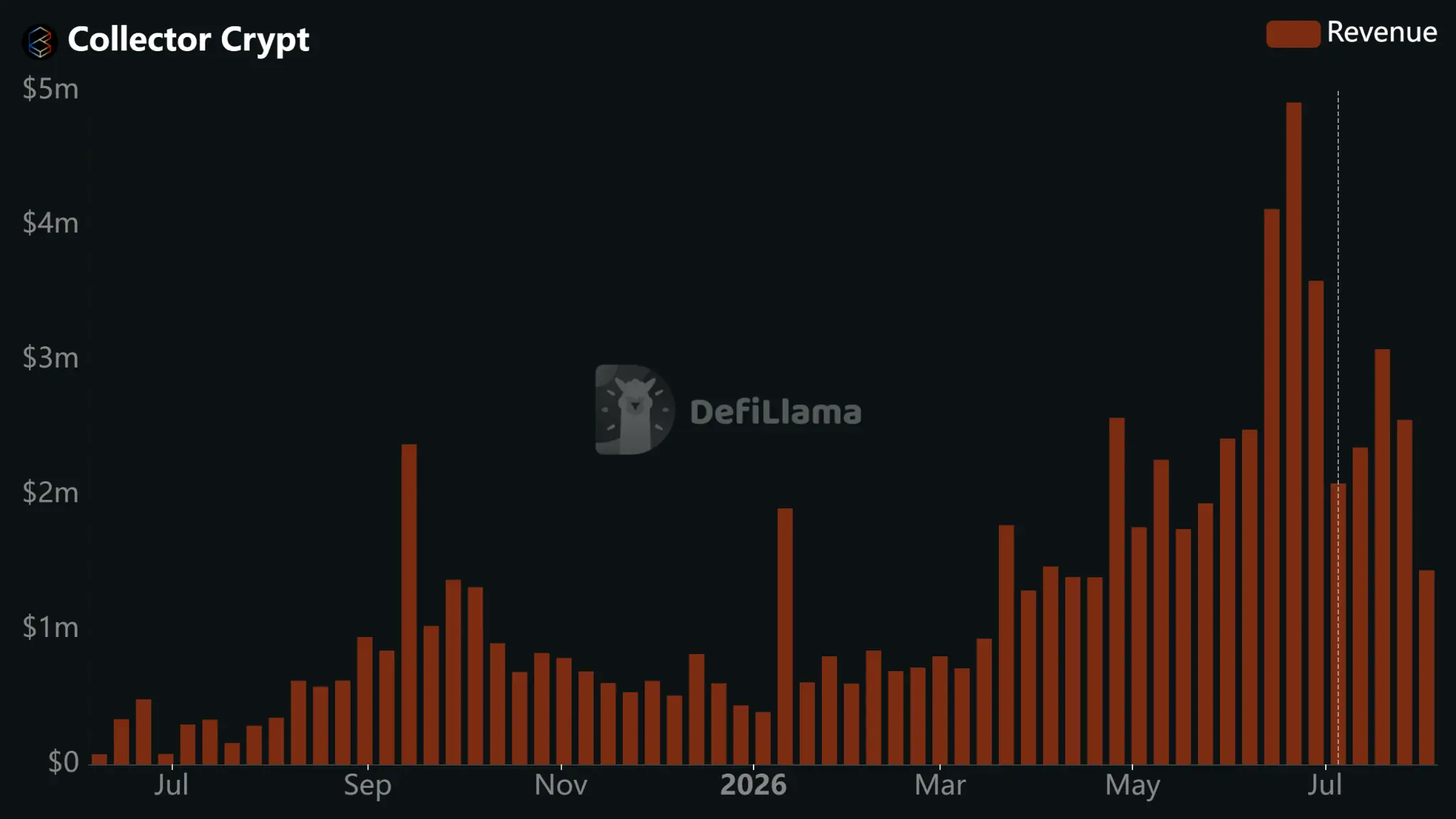
Despite Collector Crypt’s success as a business, there is no guarantee that this success will translate into value for the CARDS token. A Four Pillars investigation reached a similar conclusion: the business appears substantial, but the mechanism transferring foundation value to CARDS holders remains unclear. As a result, investing in CARDS offers speculative exposure to Collector Crypt’s ecosystem, but holding the token isn’t company equity and doesn’t provide a guaranteed claim on the platform’s revenue or profit.
Methodology and limitations
I compared and confirmed findings from publicly available Dune dashboards, Bitquery, DefiLlama, and independent research. I didn’t independently reconstruct every Collector Crypt opening or wallet.
I also conducted the nine-pack Jupiter Gacha test described above. I recorded the pack price and compared it with the USDC received through instant buybacks, then cross-checked the receipts against the corresponding Solana transactions. The test is a first-hand case study, not a platform-wide estimate, and its wallet and transaction identifiers are intentionally withheld for privacy.
The available studies are not directly comparable because they measure different periods and parts of Collector Crypt. Bitquery analyzed identified wallets and pack activity between December 7, 2025, and July 13, 2026, while DefiLlama tracks a broader period and includes both on-chain and fiat-funded pack sales. Individual Dune dashboards may cover different contracts, wallets, or product interfaces, such as Collector Crypt’s original platform and its Jupiter integration.
The studies may also treat retained cards differently. Buyback-based analyses count only USDC returned when users sell cards back, excluding the value of cards kept, redeemed, or sold elsewhere. Product mechanics, pack configurations, and buyback rates may also have changed during the observation periods. These differences help explain why reported spending totals and return rates don’t always match.
Frequently asked questions
Is Collector Crypt legit?
Yes, Collector Crypt is a legit platform that holds vaulted and graded cards and enables users to open and trade the tokenized versions of those cards.
Are Collector Crypt packs profitable?
In Bitquery’s realized-cash analysis, approximately 22% of analyzed wallets received more cash than they spent during the study period. In my small nine-pack Jupiter Gacha test, I spent $225 and received $203.15 through instant buybacks, a 90.29% realized buyback RTP.
What does insured value mean?
Insured value is the estimated dollar value assigned to a physically vaulted trading card.
Can Collector Crypt cards be redeemed?
Yes, users can burn their NFT and redeem the physical card at any time. This process includes a 2% fee, plus shipping and taxes.
How does the instant buyback work?
The rate and availability depend on the pack and interface. Jupiter Gacha guarantees a buyback of at least 85% of the card’s insured value, paid in USDC and available for three days after the pull. The percentage varies by pack and may change over time.
Is Jupiter Gacha powered by Collector Crypt?
Yes, Jupiter Gacha uses Collector Crypt backend infrastructure.
Is CARDS the same as owning equity in Collector Crypt?
No, CARDS is the native token of Collector Crypt and provides certain ecosystem benefits, but it doesn’t represent equity in the Collector Crypt company.
Final verdict
Collector Crypt gacha packs may be worth opening occasionally if you enjoy the experience. However, they are not a reliable way to make money. Positive EV is based on insured card values, while instant buybacks return less than the pack price on average.
In Bitquery’s realized-cash analysis, about four out of five analyzed wallets did not receive more cash than they spent during the study period.
My first-hand Jupiter Gacha test produced a similar distinction between insured value and realized cash: nine $25 packs cost $225 and returned $203.15 through instant buybacks, for a 90.29% realized buyback RTP. This is only one small sample, but it shows why a positive insured-value figure should not be treated as a guaranteed profit.
As for the CARDS token, its connection to Collector Crypt is indirect. Currently, the main token utility is to accrue gacha points each month, which you can use to open gacha packs. Holding CARDS doesn’t confer equity rights, making investment in the token purely speculative at this point.