<?xml version="1.0" encoding="utf-8"?><feed xmlns="http://www.w3.org/2005/Atom" ><generator uri="https://jekyllrb.com/" version="3.10.0">Jekyll</generator><link href="https://klimentdukovski.com/feed.xml" rel="self" type="application/atom+xml" /><link href="https://klimentdukovski.com/" rel="alternate" type="text/html" /><updated>2026-08-12T13:31:09+00:00</updated><id>https://klimentdukovski.com/feed.xml</id><title type="html">Kliment Dukovski</title><subtitle>Cryptocurrency, investing, finance, and technical writing by Kliment Dukovski.</subtitle><author><name>Kliment Dukovski</name></author><entry><title type="html">Collector Crypt Gacha Review: Are the Packs Worth It?</title><link href="https://klimentdukovski.com/articles/collector-crypt-gacha-review/" rel="alternate" type="text/html" title="Collector Crypt Gacha Review: Are the Packs Worth It?" /><published>2026-07-31T00:00:00+00:00</published><updated>2026-07-31T00:00:00+00:00</updated><id>https://klimentdukovski.com/articles/collector-crypt-gacha-review</id><content type="html" xml:base="https://klimentdukovski.com/articles/collector-crypt-gacha-review/"><![CDATA[<link rel="stylesheet" href="/assets/css/passive-income-article.css" />

<p>Collector Crypt is the latest craze in the NFT space, but is it worth it? At first glance, the Collector Crypt gacha appears to have a positive expected value, especially as advertised on the site. However, independent on-chain analyses found that most wallets did not finish ahead in realized cash, despite the platform generating substantial revenue.</p>

<p>This Collector Crypt review explains how the gacha packs work, what “positive EV” actually measures, how much spending has been returned through instant buybacks, and whether the platform’s growth strengthens the investment case for CARDS.</p>

<h2 id="quick-verdict-are-collector-crypt-packs-worth-it">Quick verdict: Are Collector Crypt packs worth it?</h2>

<p>Collector Crypt packs may be worth opening occasionally by collectors who value the entertainment and are comfortable keeping tokenized cards or trading them. However, they are not a reliable investment strategy.</p>

<p>The advertised EV is typically based on insured card values, while instant buybacks return only a percentage of that value. Independent on-chain research shows that realized cash returns are lower than the headline EV suggests.</p>

<table>
  <thead>
    <tr>
      <th>Key finding</th>
      <th>What it means</th>
    </tr>
  </thead>
  <tbody>
    <tr>
      <td>Advertised EV can exceed 100%</td>
      <td>It is based on insured card values, not guaranteed cash returns</td>
    </tr>
    <tr>
      <td>A $50 pack may have only $47.06 of expected instant-buyback value</td>
      <td>That equals approximately 94.1% immediately realizable RTP</td>
    </tr>
    <tr>
      <td>Major analyses found 91.85%–94.2% buyback RTP</td>
      <td>Around 5.8%–8.2% of spending was not returned through identifiable buybacks</td>
    </tr>
    <tr>
      <td>Only 22% of analyzed wallets finished ahead in cash</td>
      <td>Most wallets did not realize a cash profit during Bitquery’s study period</td>
    </tr>
    <tr>
      <td>The median wallet result was approximately −$50</td>
      <td>A few larger winners raised the average above the typical outcome</td>
    </tr>
    <tr>
      <td>714 wallets generated roughly 88% of analyzed spending</td>
      <td>Collector Crypt’s activity is heavily concentrated among high-volume users</td>
    </tr>
    <tr>
      <td>CARDS is not equity in Collector Crypt</td>
      <td>Token holders do not automatically receive the company’s revenue or profits</td>
    </tr>
  </tbody>
</table>

<p>Buyback RTP (Return to Player) excludes cards that users kept, redeemed, or sold elsewhere. Figures also vary by source because each analysis covers a different period and dataset. Sources and methodologies are detailed below.</p>

<h2 id="what-is-collector-crypt">What is Collector Crypt?</h2>

<p>Collector Crypt is a Solana-based platform that represents physically vaulted and graded trading cards as redeemable digital tokens (NFTs). These include mostly Pokémon cards, as well as anime pop culture and sports cards.</p>

<p>The platform features a gacha machine, a gamified, randomized pack-opening system that lets users draw cards backed by actual vaulted assets. Users can redeem their NFTs for the real cards if they want to, or sell them on the NFT marketplace.</p>

<figure class="article-figure">
  <img src="/assets/images/collector-crypt-weekly-spending-dune.webp" alt="Weekly USDC spending on Collector Crypt gacha packs from December 2025 to July 2026" width="1415" height="666" loading="lazy" decoding="async" />
  <figcaption><a href="https://dune.com/queries/7601588/11554432">Weekly USDC spending on Collector Crypt packs</a> | AX1, Dune</figcaption>
</figure>

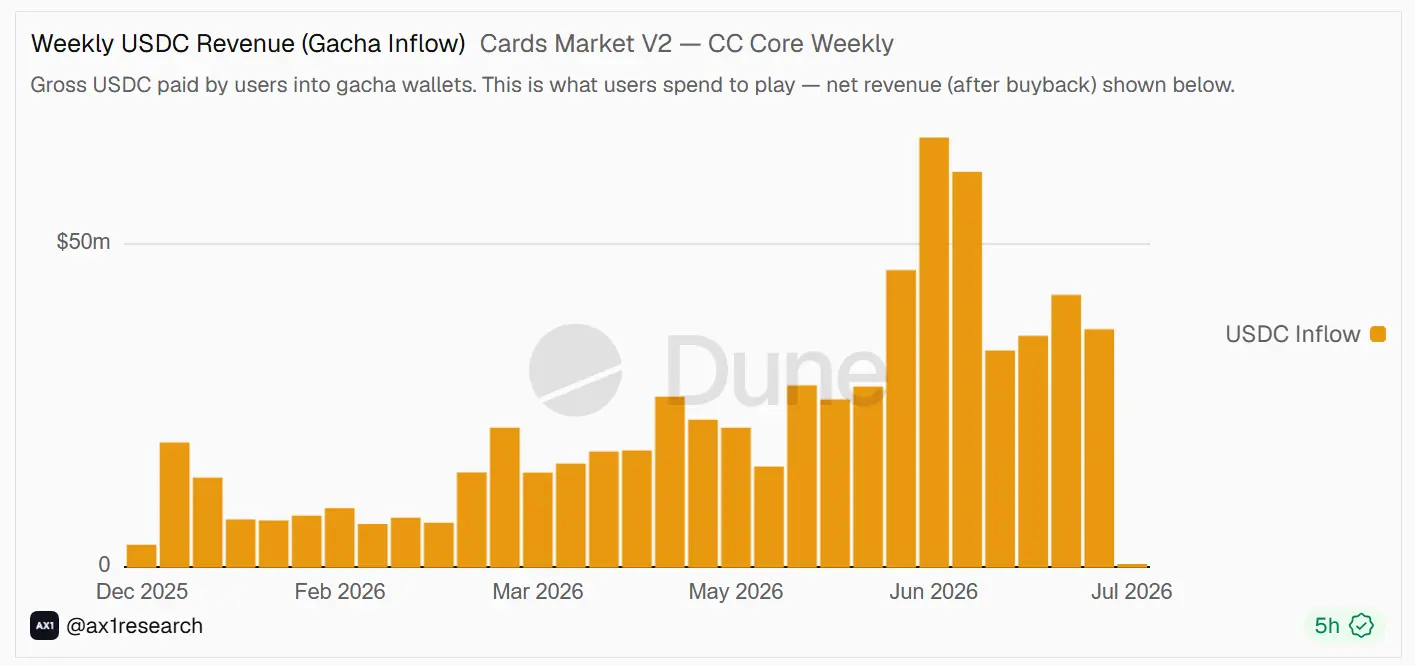
<p>On-chain data show that users have already spent nearly $700 million on card purchases from December 2025 to July 2026. Weekly spending rose from below $10 million to a peak of over $60 million in June 2026.</p>

<p>A portion of the platform’s revenue is used to buy more physical cards, creating a treasury-backed value model.</p>

<p>Jupiter, the largest swap aggregator and a DEX on Solana, launched <a href="https://jup.ag/gacha/packs/pokemon_50">Jupiter Gacha</a> in partnership with Collector Crypt, bringing the product to millions of users. Within the first five days, <a href="https://x.com/JupiterExchange/status/2078142543250772162?s=20">Jupiter Gacha saw $9 million</a> in packs opened.</p>

<aside class="article-callout article-callout--important" aria-label="Important">

  <p>The term <strong>Gacha</strong> comes from Japanese capsule-toy vending machines, which make the sound “gachapon” (or “gashapon”) when they dispense the capsules with random toy prizes.</p>

</aside>

<h2 id="how-do-collector-crypt-gacha-packs-work">How do Collector Crypt Gacha packs work?</h2>

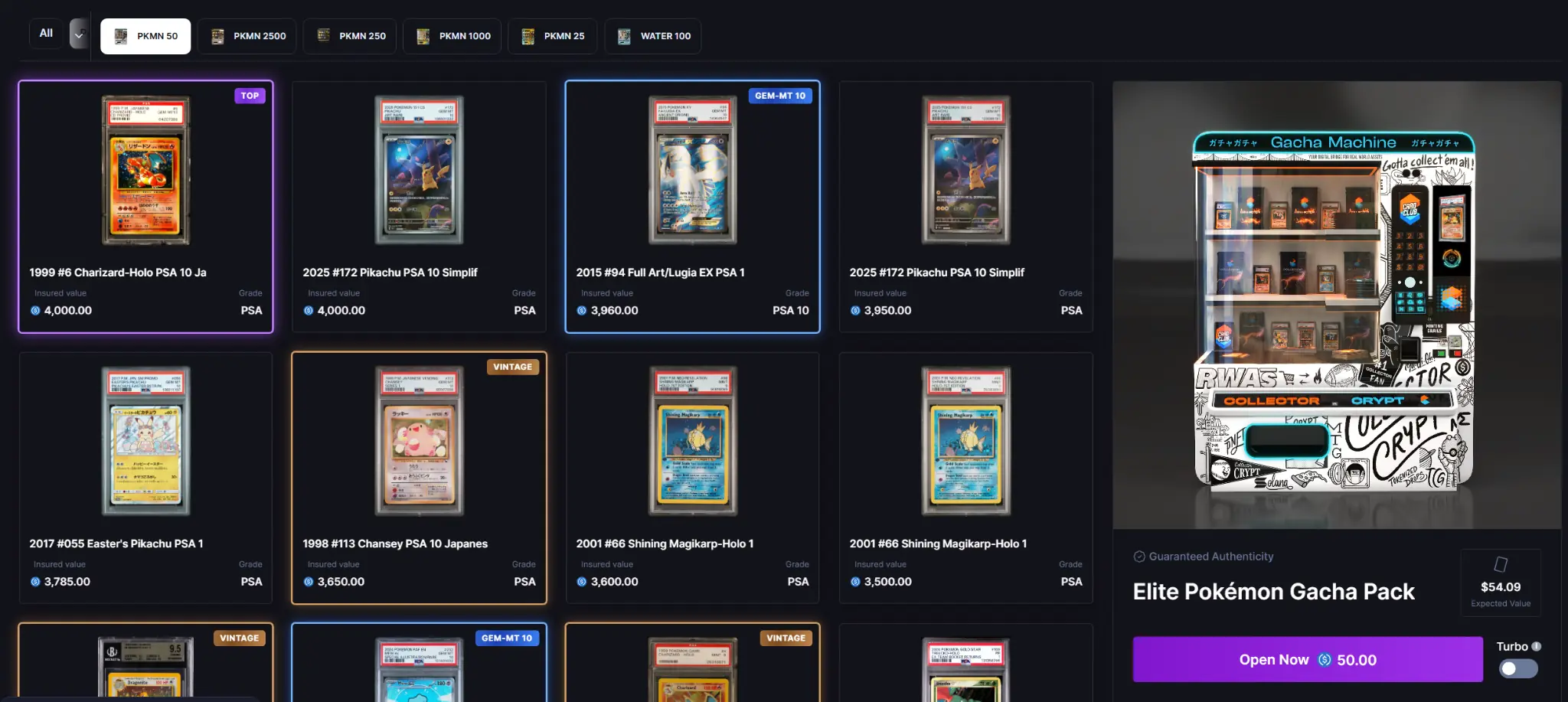
<p>The gacha is a gamified machine that opens randomized packs containing tokenized versions of real cards stored in secure vaults.</p>

<figure class="article-figure">
  <img src="/assets/images/collector-crypt-gacha-machine.webp" alt="Collector Crypt gacha machine showing tokenized Pokémon card packs" width="2048" height="917" loading="lazy" decoding="async" />
  <figcaption>Gacha machine | Collector Crypt</figcaption>
</figure>

<p>Users select the pack type they want to open based on price ($25, $50, $100, $250, $1,000, $2,500). Regardless of the pack type chosen, the Collector Crypt page will display:</p>

<ul>
  <li>
    <p><strong>Expected value</strong>, a metric that’s always above the purchase price.</p>
  </li>
  <li>
    <p><strong>Instant buyback offer</strong>, between 85% and 94% of the card’s value.</p>
  </li>
  <li>
    <p><strong>Statistics</strong> showing the odds of receiving common, uncommon, rare, or epic cards.</p>
  </li>
</ul>

<p>Collector Crypt has made it seamless to buy these cards with bank cards, crypto, Cash App, Google Pay, or Apple Pay.</p>

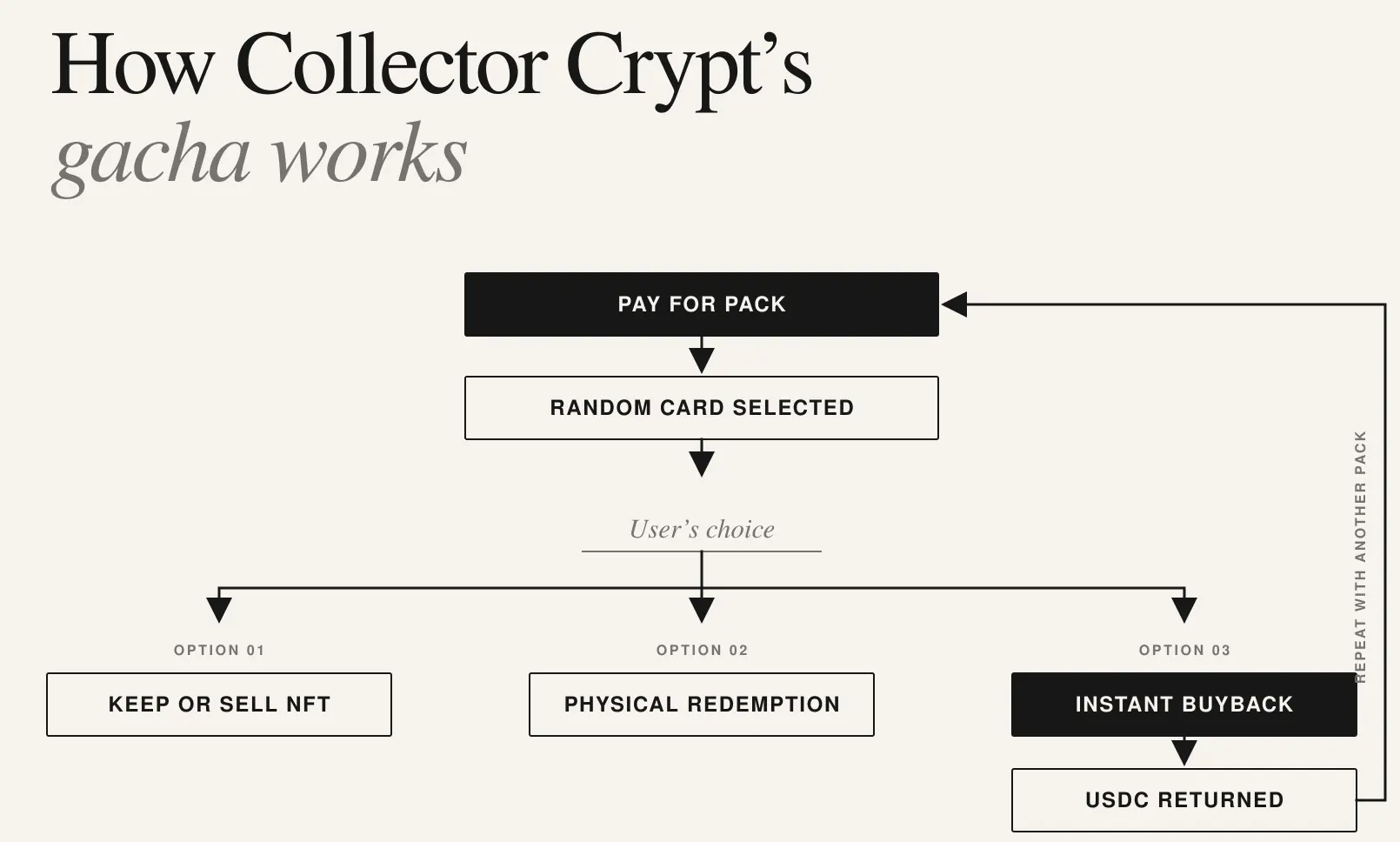
<p>One useful feature is instant buybacks for drawn cards, allowing users to sell their cards as soon as they are opened without liquidity concerns. Granted, instant buybacks come at a lower price than what users can get by holding their cards or selling them on the marketplace. But at least they guarantee instant liquidity, even at a potential loss.</p>

<p>There’s also a <em>turbo</em> switch that instantly sells common cards, enabling users to “hunt for the grail at maximum speed”.</p>

<p>Users can list their cards on the marketplace to sell them for a higher price than the buyback price, or redeem them for a physical card, which will be delivered to the address they provide.</p>

<figure class="article-figure">
  <img src="/assets/images/collector-crypt-gacha-flowchart.webp" alt="Flowchart showing how a Collector Crypt gacha pack leads to keeping, redeeming, or instantly selling the selected card" width="1610" height="968" loading="lazy" decoding="async" />
  <figcaption>How Collector Crypt gacha packs work</figcaption>
</figure>

<p>When buying the cards, users see the “expected value,” which is always higher than the pack’s price. For example, a pack that costs $50 can have a positive expected value of $54.13.</p>

<h2 id="what-does-positive-expected-value-mean">What does positive expected value mean?</h2>

<p>A positive expected value means that, on average across multiple pack openings, the value of the cards a user receives exceeds the amount spent.</p>

<p>For example, if a pack costs $50 and the stated expected value is $54.13, the pack’s expected net insured value is:</p>

<p>$54.13 – $50.00 = $4.13</p>

<p>However, this doesn’t mean you should expect to profit $4.13 from every $50 pack. Sometimes you could receive a card worth $20, other times a card worth $30, and maybe a rare card worth $500. The expected value is just a theoretical average, calculated as:</p>

<p>EV=∑(outcome probability×outcome value)</p>

<p>More importantly, a positive insured-value EV doesn’t mean a positive cash EV. A user may need to keep, redeem, or manually sell the card on the marketplace to capture its assigned value.</p>

<p>So a $50 pack could have:</p>

<table>
  <thead>
    <tr>
      <th>Measurement</th>
      <th>Amount</th>
    </tr>
  </thead>
  <tbody>
    <tr>
      <td>Expected insured value</td>
      <td>$54.13</td>
    </tr>
    <tr>
      <td>Expected net insured value</td>
      <td>$4.13</td>
    </tr>
    <tr>
      <td>Expected instant-buyback value</td>
      <td>Approximately $46</td>
    </tr>
    <tr>
      <td>Immediately realizable cash return</td>
      <td>Approximately 92%</td>
    </tr>
    <tr>
      <td>Expected net cash result</td>
      <td>Approximately –$4.00</td>
    </tr>
  </tbody>
</table>

<p>The instant buyback value is lower because it represents 85% of the expected insured value:</p>

<p>$54.13 x 85% ≈ $46.00</p>

<p>As a result, each pack can have a positive expected value based on insured card prices yet a negative expected value when measured by immediately realizable cash (the Collector Crypt 85% instant buyback option).</p>

<h2 id="what-the-on-chain-data-shows">What the on-chain data shows</h2>

<p>While at first glance it seems every pack is worth more than it costs, on-chain data paints a different picture.</p>

<h3 id="collector-crypts-realized-buyback-rtp">Collector Crypt’s realized buyback RTP</h3>

<table>
  <thead>
    <tr>
      <th>Source</th>
      <th>Observation period</th>
      <th>User spending</th>
      <th>USDC returned to users through card buybacks*</th>
      <th>Buyback-to-sales ratio</th>
    </tr>
  </thead>
  <tbody>
    <tr>
      <td><a href="https://bitquery.io/investigations/collector-crypt-jupiter-gacha">Bitquery</a></td>
      <td>December 2025 – July 2026</td>
      <td>$622.6 million</td>
      <td>$586.6 million</td>
      <td>94.2%</td>
    </tr>
    <tr>
      <td><a href="https://defillama.com/protocol/collector-crypt">DefiLlama</a></td>
      <td>June 2025 – July 2026</td>
      <td>$879.4 million</td>
      <td>$807.7 million</td>
      <td>91.85%</td>
    </tr>
  </tbody>
</table>

<p>* Retained cards by users are excluded from realized-cash calculations.</p>

<h3 id="did-most-wallets-make-money">Did most wallets make money?</h3>

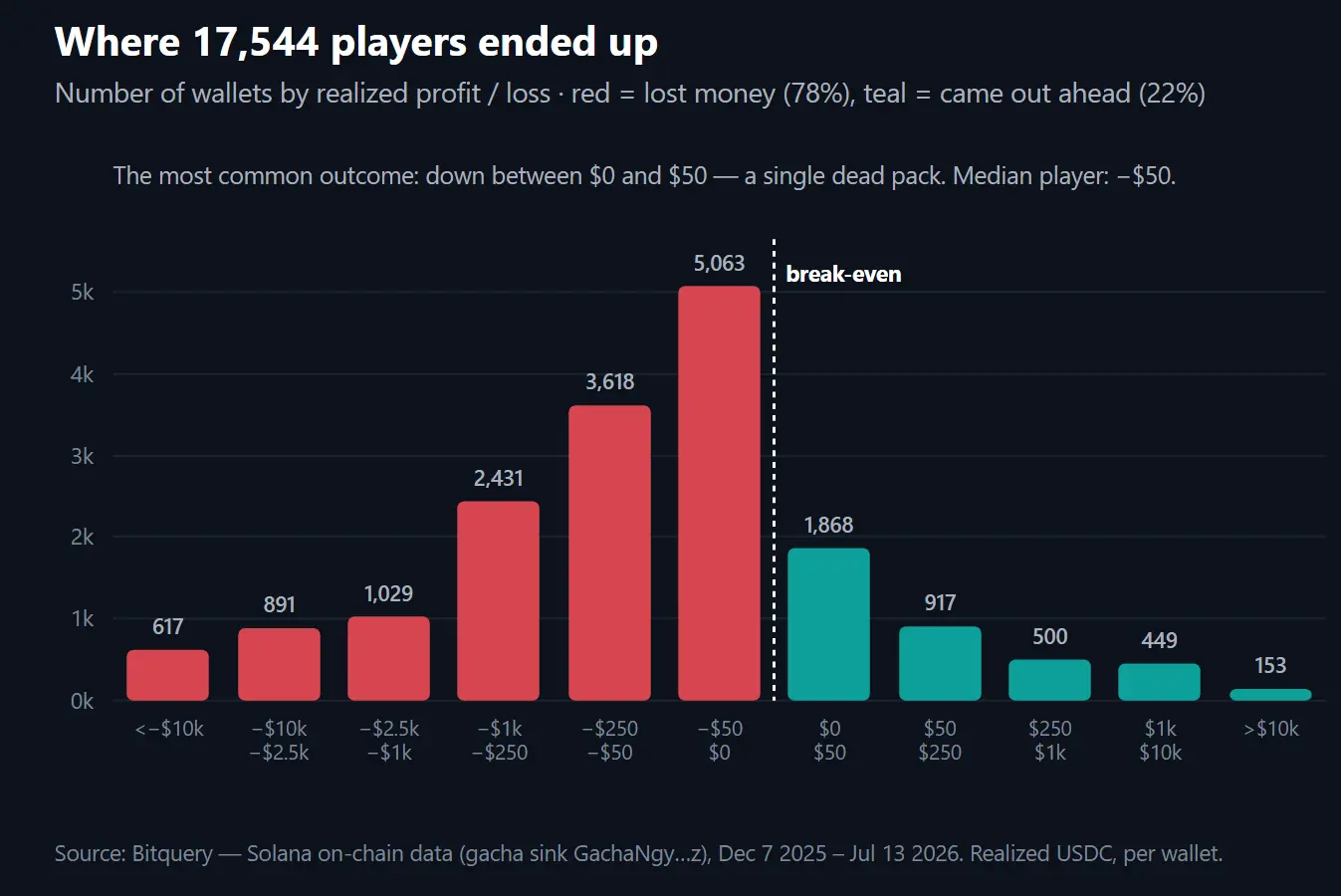
<p>Approximately 22% of the analyzed wallets received more cash than they spent, according to <a href="https://bitquery.io/investigations/collector-crypt-jupiter-gacha">Bitquery’s realized-cash analysis</a>, while the median wallet result was approximately –$50.</p>

<figure class="article-figure">
  <img src="/assets/images/collector-crypt-wallet-results-bitquery.webp" alt="Bitquery chart showing realized profit and loss across 17,544 Collector Crypt wallets" width="1347" height="900" loading="lazy" decoding="async" />
  <figcaption>Realized profit and loss across 17,544 analyzed wallets | Bitquery</figcaption>
</figure>

<p>Probably the most discouraging finding was that those who spent more had the worst pulls. 714 wallets spent over $100,000 on pack openings, with an average loss of $41,302 per wallet. These are the biggest spenders, accounting for $550 million of all packs opened.</p>

<p>Those who spent under $50 on one or two tries got better results 29% of the time and almost broke even on average.</p>

<p>Although the original appeal and the advertisement evoke card-collecting nostalgia, Bitquery’s analysis showed that 68% of all pulls were instantly sold to Collector Crypt’s buyback mechanism, revealing that profit-seeking is the prevailing goal.</p>

<p>This means the headline gacha volume is not fresh capital but rather <em>recycled</em> cash from users who instantly sell their cards and use the proceeds to open another pack. In the end, the results are clear: one in every five players got more money than they spent.</p>

<p>One of the best takes in this analysis is that “the jackpots are real and visible and the losses are quiet and private”.</p>

<h2 id="what-can-you-do-with-a-collector-crypt-card">What can you do with a Collector Crypt card?</h2>

<p>Once you open the pack, you have four options in Collector Crypt:</p>

<table>
  <thead>
    <tr>
      <th>Option</th>
      <th>Benefit</th>
      <th>Drawbacks</th>
    </tr>
  </thead>
  <tbody>
    <tr>
      <td>Keep the tokenized card</td>
      <td>Retain exposure to the collectible</td>
      <td>Price and liquidity risk</td>
    </tr>
    <tr>
      <td>Instant buyback</td>
      <td>Immediate USDC</td>
      <td>Discount to insured value</td>
    </tr>
    <tr>
      <td>Marketplace sale</td>
      <td>Choose the asking price</td>
      <td>Fee and uncertain sale time</td>
    </tr>
    <tr>
      <td>Physical redemption</td>
      <td>Receive the graded card</td>
      <td>Shipping, VAT, and customs</td>
    </tr>
  </tbody>
</table>

<p>Collector Crypt lets you select multiple cards at once to list them on the marketplace in bulk, priced according to insured value. You can adjust the price if needed.</p>

<p>For instant buybacks, you can request them at any time, with no expiration window. Simply submit a request, receive an offer, and decide whether to sell.</p>

<aside class="article-callout article-callout--important" aria-label="Important">

  <p>If you want to redeem your Collector Crypt card, here’s how to do it:</p>

  <ol>
    <li>
      <p><strong>Open your Collector Crypt profile</strong> and select My Collection.</p>
    </li>
    <li>
      <p><strong>Select the cards you wish to redeem,</strong> then select the Burn icon.</p>
    </li>
    <li>
      <p><strong>Review the selected cards</strong> to confirm you chose the right ones.</p>
    </li>
    <li>
      <p><strong>Select Burn PNFTs</strong> to remove the tokenized version of the card from the blockchain.</p>
    </li>
    <li>
      <p><strong>Provide your shipping address</strong> for your card to arrive.</p>
    </li>
  </ol>

  <p><strong>Note:</strong> There’s a 2% redemption fee, plus a $5.99 shipping fee for the first card in the US ($10.99 for shipments over $500). For each additional card you redeem, there’s a $3 shipping fee. Collector Crypt publishes its current regional rates and insurance charges in its <a href="https://docs.collectorcrypt.com/vault/shipping-api#rate-summary">shipping documentation</a>.</p>

  <p>Shipping to Canada, Europe, and the rest of the world is much more expensive.</p>

  <ul>
    <li>
      <p>Canadians pay $20.99 for the first card + $3 for each additional card</p>
    </li>
    <li>
      <p>EU users pay $29.99 + $3 for each additional card</p>
    </li>
    <li>
      <p>Rest of World pays $34.99 for the first card + $3 for each additional card</p>
    </li>
  </ul>

  <p>All shipments are insured up to $5,000. Shipments over $5,000 are covered at a 0.5% fee.</p>

</aside>

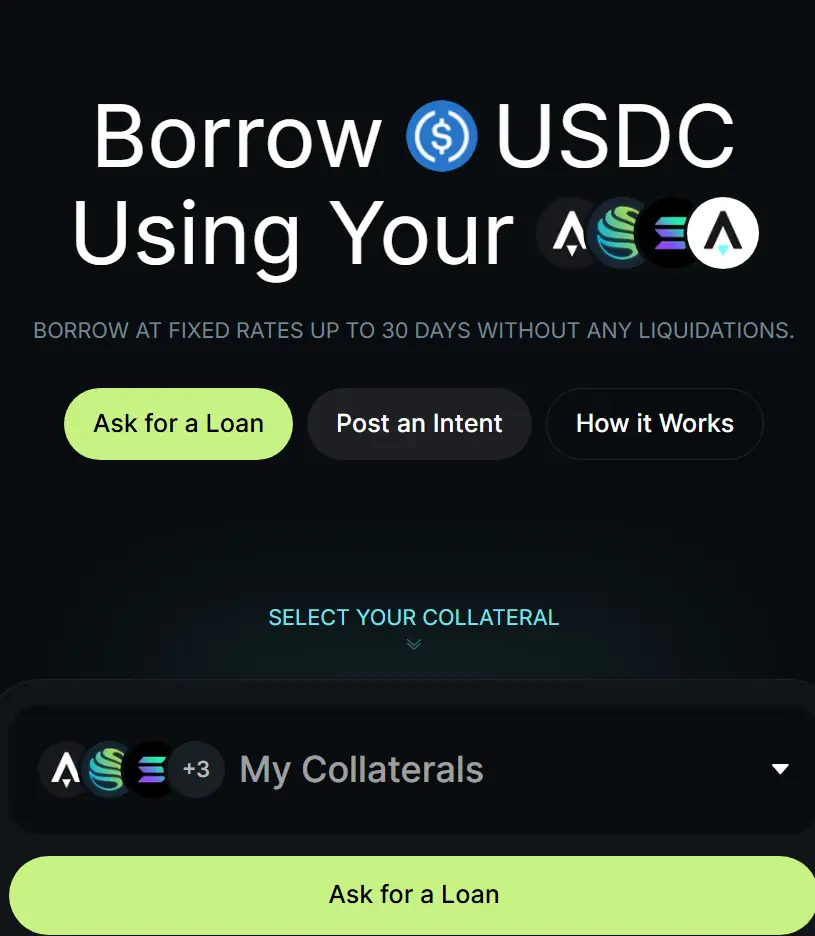
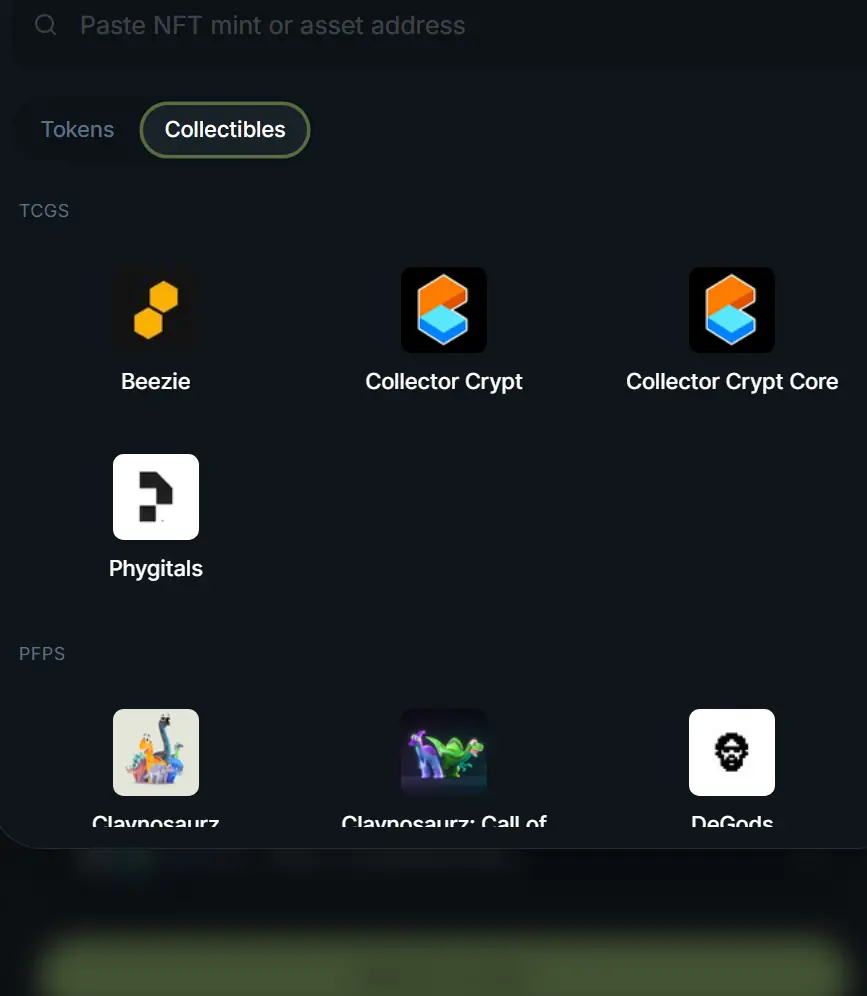
<p>If you decide to keep your cards, there’s a bonus option: borrow against them on Jupiter’s Offerbook.</p>

<p>Here’s how it works:</p>

<ol>
  <li>Visit Jupiter’s Offerbook.</li>
  <li>Select <strong>My Collaterals</strong>.</li>
</ol>

<figure class="article-figure article-figure-portrait">
  <img src="/assets/images/jupiter-offerbook-collateral.webp" alt="Jupiter Offerbook screen with My Collaterals selected" width="815" height="936" loading="lazy" decoding="async" />
  <figcaption>Select My Collaterals in Jupiter Offerbook</figcaption>
</figure>

<ol start="3">
  <li>Select <strong>Collectibles</strong> from the top options.</li>
</ol>

<figure class="article-figure article-figure-portrait">
  <img src="/assets/images/jupiter-offerbook-collectibles.webp" alt="Jupiter Offerbook screen showing Collector Crypt under Collectibles" width="867" height="996" loading="lazy" decoding="async" />
  <figcaption>Select Collector Crypt under Collectibles</figcaption>
</figure>

<ol start="4">
  <li>Select <strong>Collector Crypt.</strong></li>
  <li>Choose the card you wish to use as a collateral.</li>
  <li>Select <strong>Ask for a Loan</strong>.</li>
  <li>Fill out the details, such as APR, loan term, and the amount you’re requesting.</li>
  <li>Wait for lenders to accept your offer.</li>
</ol>

<h2 id="is-collector-crypt-fair">Is Collector Crypt fair?</h2>

<p>Collector Crypt uses <a href="https://docs.collectorcrypt.com/gacha/vrf">a Verifiable Random Function (VRF)</a>, which can be seen as a random-number generator that produces a cryptographic receipt. Users can then verify that the pack’s result was generated according to the published process rather than being secretly generated in the background by Collector Crypt.</p>

<p>Here’s how the process works:</p>

<ol>
  <li>
    <p>When you buy a pack, your wallet signature creates an unpredictable input.</p>
  </li>
  <li>
    <p>The VRF uses that input to generate a random result and a cryptographic proof.</p>
  </li>
  <li>
    <p>One part of the result determines the card’s rarity (common, uncommon, rare, or epic).</p>
  </li>
  <li>
    <p>Another part selects a card from the pool of eligible cards.</p>
  </li>
</ol>

<p>The result and additional information are recorded on the Solana blockchain. Users can enter the pack’s memo on Collector Crypt’s verification page to confirm that the result matches the on-chain records. If there’s any tampering, the verification would fail.</p>

<p>You can also verify by opening:</p>

<p><code class="language-plaintext highlighter-rouge">/verify-selection/YOUR_MEMO</code> in your browser</p>

<p>Call <code class="language-plaintext highlighter-rouge">GET /api/vrf/verify?memo=YOUR_MEMO</code></p>

<h2 id="collector-crypt-risks">Collector Crypt risks</h2>

<p>While opening Collector Crypt packs can be a fun and engaging way to try your luck at finding a rare card, there are risks to consider.</p>

<p>First, there are no guarantees that the cards you open will be worth more than you paid for your pack. In fact, there’s a negative cash EV with instant buybacks. Bitquery analyzed on-chain results and found that only 22% of wallets made more money than they spent on packs. That means four out of five wallets lost money. This was especially pronounced among those who repeatedly opened new packs.</p>

<p>The <em>turbo</em> pack-opening feature can encourage loss-chasing because it instantly sells common cards and recycles the USDC into new packs. If rapid reopening makes it harder to stick to a budget, turn off turbo and set a firm spending limit before opening packs.</p>

<p>Collector Crypt has further automated this loop through a separate tab called Yolo. Users enter the amount of USDC they want to spend, and the platform buys packs, opens them, and sells common cards automatically. This increases the risk of rapid loss-chasing.</p>

<p>On top of these risks, there are operational risks of custody, redemption, shipping, and smart contract exploits. Even though Collector Crypt ensures that everything goes smoothly, no one can guarantee the complete safety of your cards.</p>

<h2 id="how-does-collector-crypt-make-money">How does Collector Crypt make money?</h2>

<p>Collector Crypt primarily earns revenue from the difference between pack payments and the amount returned to users through card buybacks. Once a card is bought back at a <em>discount,</em> it is rolled back into new pack openings, where users pay a higher price.</p>

<p>This allows the same physical card to support multiple pack openings. Similarly, USDC returned to users can be spent on another pack, meaning the initial deposit can generate recurring pack sales volume.</p>

<p>Based on <a href="https://defillama.com/protocol/collector-crypt">DefiLlama data</a> on July 30, 2026, Collector Crypt has processed approximately:</p>

<table>
  <thead>
    <tr>
      <th>Measurement</th>
      <th>Amount</th>
    </tr>
  </thead>
  <tbody>
    <tr>
      <td>Gacha pack sales</td>
      <td>$893.23 million</td>
    </tr>
    <tr>
      <td>USDC returned to users through card buybacks</td>
      <td>$820.42 million</td>
    </tr>
    <tr>
      <td>Retained spread before inventory and operating cost</td>
      <td>$72.81 million</td>
    </tr>
    <tr>
      <td>Marketplace royalties</td>
      <td>$2.79 million</td>
    </tr>
    <tr>
      <td>DefiLlama-tracked protocol revenue</td>
      <td>$75.60 million</td>
    </tr>
  </tbody>
</table>

<p>Over the full period tracked in DefiLlama’s income statement, approximately 91.85% of pack payments were returned to users through card buybacks.</p>

<p>Notably, the $72.81 million retained from gacha pack activity should not be described as profit, as DefiLlama doesn’t deduct potential material costs such as purchasing new cards, grading, insurance and custody, staff, technology, marketing, and all other expenses.</p>

<h3 id="marketplace-royalties">Marketplace royalties</h3>

<p>Another revenue source for the company is fees collected when cards are traded through its marketplace. DefiLlama recorded about $2.79 million in cumulative marketplace royalties, which is substantially less than the retained spread from gacha activity, but it’s still strong.</p>

<h2 id="collector-crypt-token-cards-is-it-a-good-investment">Collector Crypt token CARDS: is it a good investment?</h2>

<p>Collector Crypt launched its native token, CARDS, in August 2025, with a total supply of 2 billion. Reported circulating supply differed across trackers on July 31, 2026: <a href="https://defillama.com/protocol/collector-crypt">DefiLlama displayed approximately 257.55 million</a>, while <a href="https://www.binance.com/en/price/collector-crypt">Binance displayed approximately 415.9 million</a>.</p>

<p>The token’s primary utility is earning gacha points each month based on how many CARDS tokens you hold in your wallet. The current rate is 0.4 points per CARDS token. These points can be used to open packs on the Collector Crypt platform, according to <a href="https://discord.com/invite/CollectorCrypt">Collector Crypt’s Discord information</a>.</p>

<table>
  <thead>
    <tr>
      <th>Pack</th>
      <th>Points required</th>
      <th>CARDS required to earn that many points each month</th>
    </tr>
  </thead>
  <tbody>
    <tr>
      <td>$50 Elite</td>
      <td>100,000</td>
      <td>250,000 CARDS</td>
    </tr>
    <tr>
      <td>$250 Legendary</td>
      <td>500,000</td>
      <td>1.25 million CARDS</td>
    </tr>
    <tr>
      <td>$1,000 Grail</td>
      <td>2 million</td>
      <td>5 million CARDS</td>
    </tr>
  </tbody>
</table>

<p>If you don’t have enough points for a pack, you can accrue them over multiple months because points don’t expire.</p>

<p>At $0.15 per CARDS token, you need to pay $37,500 to buy 250,000 CARDS tokens, which will accrue 100,000 points for a $50 Elite pack each month, assuming 0.4 points per 1 CARDS token remains unchanged.</p>

<p>However, if you use the platform, you can earn CARDS tokens every quarter based on several factors, including:</p>

<ul>
  <li>
    <p>Gacha points</p>
  </li>
  <li>
    <p>The value of cards you hold</p>
  </li>
  <li>
    <p>The value of physical cards withdrawn</p>
  </li>
  <li>
    <p>Use of Collector Crypt’s eBay sniper tool</p>
  </li>
  <li>
    <p>The ownership of Card Club NFTs</p>
  </li>
</ul>

<aside class="article-callout article-callout--important" aria-label="Important">

  <p>Collector Crypt offers an eBay <a href="https://bid.collectorcrypt.com/">sniper tool</a> that lets users select a card already listed on eBay and place bids on their behalf at the last possible moment. If successful, the card is bought, vaulted, and tokenized, with a 1% fee. Unsuccessful bids are refunded to users. If the card is bought, it’s sent directly to the user’s wallet.</p>

  <p>Card Club NFTs are a premium pass to the Collector Crypt ecosystem, granting access to exclusive features. Currently, Card Club NFTs are available only on <a href="https://magiceden.io/marketplace/collectorcardclub">secondary marketplaces</a>.</p>

</aside>

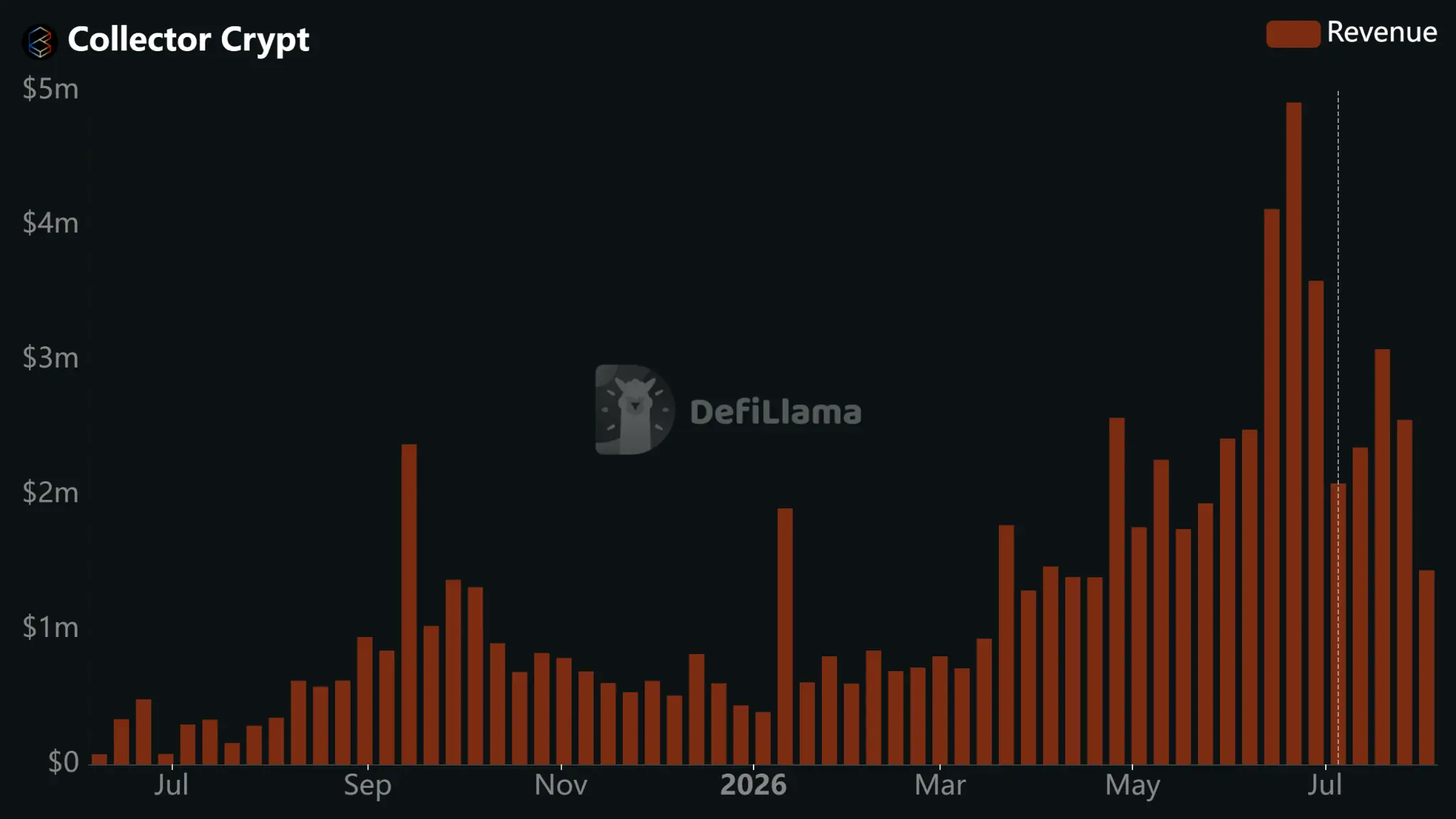
<p>The bull case for CARDS is that it is the native token of a real business with growing revenue, exceeding $70 million since its 2025 launch, according to <a href="https://defillama.com/protocol/collector-crypt">DefiLlama</a>. <a href="https://pineanalytics.substack.com/p/collector-crypt-quarterly-report">Pine Analytics’ first-quarter report</a> also estimated $146.9 million in quarterly revenue and $8.6 million in gross profit, although its methodology differs from DefiLlama’s.</p>

<figure class="article-figure">
  <img src="/assets/images/collector-crypt-weekly-revenue-defillama.webp" alt="DefiLlama chart showing Collector Crypt weekly protocol revenue" width="2048" height="1152" loading="lazy" decoding="async" />
  <figcaption>Collector Crypt weekly protocol revenue | DefiLlama</figcaption>
</figure>

<p>Despite Collector Crypt’s success as a business, there is no guarantee that this success will translate into value for the CARDS token. A <a href="https://research.4pillars.io/en/research/collcector-crypt-has-one-question-left">Four Pillars investigation</a> reached a similar conclusion: the business appears substantial, but the mechanism transferring foundation value to CARDS holders remains unclear. As a result, investing in CARDS offers speculative exposure to Collector Crypt’s ecosystem, but holding the token isn’t company equity and doesn’t provide a guaranteed claim on the platform’s revenue or profit.</p>

<aside class="article-callout article-callout--important" aria-label="Important">

  <h3 id="how-to-buy-cards">How to buy CARDS?</h3>

  <p>If you want to buy the CARDS token, here’s a step-by-step guide:</p>

  <ol>
    <li>
      <p><strong>Download a Solana wallet</strong> if you don’t already have one. I recommend the Jupiter wallet for its low fees and access to features unavailable in other wallets. Phantom, Solflare, and Backpack are also excellent options.</p>
    </li>
    <li>
      <p><strong>Create a wallet account</strong> and keep your seed phrase on paper. Don’t take photos of your seed phrase or store it digitally on your computer.</p>
    </li>
    <li>
      <p><strong>Fund the wallet</strong> by purchasing SOL with a card, Apple Pay, or Google Pay directly in the wallet app. If you already have SOL on a centralized exchange like Kraken or Coinbase, send it to your wallet.</p>
    </li>
    <li>
      <p><strong>Open Jupiter Swap,</strong> find the CARDS token, and enter the amount of SOL you want to swap for CARDS.</p>
    </li>
    <li>
      <p><strong>Confirm the transaction details</strong> and approve the swap. Your CARDS should appear in your wallet.</p>
    </li>
  </ol>

  <p><strong>Note:</strong> always keep a small amount of SOL in your wallet to pay transaction fees (0.2 is more than enough).</p>

  <p>This is the correct CARDS token address: CARDSccUMFKoPRZxt5vt3ksUbxEFEcnZ3H2pd3dKxYjp</p>

  <p>Check out <a href="https://jup.ag/?ref=exnjlv6tzivh" rel="sponsored nofollow">Jupiter swap</a>.</p>

  <p><em>Affiliate disclosure: I may earn a commission if you sign up or use this platform through my link, at no additional cost to you. I recommend Jupiter because I use it daily and honestly believe it’s the best swap product on Solana.</em></p>

</aside>

<h2 id="methodology-and-limitations">Methodology and limitations</h2>

<p>I compared and confirmed findings from publicly available Dune dashboards, Bitquery, DefiLlama, and independent research. I didn’t independently reconstruct every Collector Crypt opening or wallet.</p>

<p>The available studies are not directly comparable because they measure different periods and parts of Collector Crypt. Bitquery analyzed identified wallets and pack activity between December 7, 2025, and July 13, 2026, while DefiLlama tracks a broader period and includes both on-chain and fiat-funded pack sales. Individual Dune dashboards may cover different contracts, wallets, or product interfaces, such as Collector Crypt’s original platform and its Jupiter integration.</p>

<p>The studies may also treat retained cards differently. Buyback-based analyses count only USDC returned when users sell cards back, excluding the value of cards kept, redeemed, or sold elsewhere. Product mechanics, pack configurations, and buyback rates may also have changed during the observation periods. These differences help explain why reported spending totals and return rates don’t always match.</p>

<h2 id="frequently-asked-questions">Frequently asked questions</h2>

<h3 id="is-collector-crypt-legit">Is Collector Crypt legit?</h3>

<p>Yes, Collector Crypt is a legit platform that holds vaulted and graded cards and enables users to open and trade the tokenized versions of those cards.</p>

<h3 id="are-collector-crypt-packs-profitable">Are Collector Crypt packs profitable?</h3>

<p>In Bitquery’s realized-cash analysis, approximately 22% of analyzed wallets received more cash than they spent during the study period.</p>

<h3 id="what-does-insured-value-mean">What does insured value mean?</h3>

<p>Insured value is the estimated dollar value assigned to a physically vaulted trading card.</p>

<h3 id="can-collector-crypt-cards-be-redeemed">Can Collector Crypt cards be redeemed?</h3>

<p>Yes, users can burn their NFT and redeem the physical card at any time. This process includes a 2% fee, plus shipping and taxes.</p>

<h3 id="how-does-the-instant-buyback-work">How does the instant buyback work?</h3>

<p>Users who open a gacha pack can select their cards and sell them back to Collector Crypt for 85% of the insured value.</p>

<h3 id="is-jupiter-gacha-powered-by-collector-crypt">Is Jupiter Gacha powered by Collector Crypt?</h3>

<p>Yes, Jupiter Gacha uses Collector Crypt backend infrastructure.</p>

<h3 id="is-cards-the-same-as-owning-equity-in-collector-crypt">Is CARDS the same as owning equity in Collector Crypt?</h3>

<p>No, CARDS is the native token of Collector Crypt and provides certain ecosystem benefits, but it doesn’t represent equity in the Collector Crypt company.</p>

<h2 id="final-verdict">Final verdict</h2>

<p>Collector Crypt gacha packs may be worth opening occasionally if you enjoy the experience. However, they are not a reliable way to make money. Positive EV is based on insured card values, while instant buybacks return less than the pack price on average.</p>

<p>In Bitquery’s realized-cash analysis, about four out of five analyzed wallets did not receive more cash than they spent during the study period.</p>

<p>As for the CARDS token, its connection to Collector Crypt is indirect. Currently, the main token utility is to accrue gacha points each month, which you can use to open gacha packs. Holding CARDS doesn’t confer equity rights, making investment in the token purely speculative at this point.</p>]]></content><author><name>Kliment Dukovski</name></author><category term="Solana" /><category term="Collector Crypt review" /><category term="Collector Crypt Gacha" /><category term="Jupiter Gacha" /><category term="CARDS token" /><category term="Solana" /><category term="Tokenized collectibles" /><summary type="html"><![CDATA[Are Collector Crypt gacha packs worth it? See how odds, insured value, instant buybacks, on-chain RTP, and CARDS token risks compare.]]></summary><media:thumbnail xmlns:media="http://search.yahoo.com/mrss/" url="https://klimentdukovski.com/assets/images/collector-crypt-gacha-review.webp" /><media:content medium="image" url="https://klimentdukovski.com/assets/images/collector-crypt-gacha-review.webp" xmlns:media="http://search.yahoo.com/mrss/" /></entry><entry><title type="html">5 Best Ways to Earn Passive Income on Solana in 2026</title><link href="https://klimentdukovski.com/articles/best-solana-passive-income/" rel="alternate" type="text/html" title="5 Best Ways to Earn Passive Income on Solana in 2026" /><published>2026-07-24T00:00:00+00:00</published><updated>2026-08-12T00:00:00+00:00</updated><id>https://klimentdukovski.com/articles/best-solana-passive-income</id><content type="html" xml:base="https://klimentdukovski.com/articles/best-solana-passive-income/"><![CDATA[<link rel="stylesheet" href="/assets/css/passive-income-article.css" />

<p>The best Solana passive income options include native SOL staking, liquid staking via tokens such as JitoSOL and jupSOL, holding JLP and JUICED tokens, and financing real-world payment activity through Huma Classic.</p>

<p>Native staking is the simplest option for long-term SOL holders, especially given SOL’s price volatility. JLP and private-credit products can offer higher yields, but they also carry other types of risk, while JUICED offers a stable yield on idle assets.</p>

<p>Rates were checked on August 12, 2026, and can change at any time.</p>

<table>
  <thead>
    <tr>
      <th><strong>Option</strong></th>
      <th><strong>Yield snapshot</strong></th>
      <th><strong>Yield source</strong></th>
      <th><strong>Best for</strong></th>
      <th><strong>Principal risk</strong></th>
    </tr>
  </thead>
  <tbody>
    <tr>
      <td>Native SOL staking</td>
      <td>4.84%–5.38%</td>
      <td>Protocol inflation, transaction fees, and MEV rewards</td>
      <td>Long-term SOL holders</td>
      <td>SOL price decline</td>
    </tr>
    <tr>
      <td>Liquid staking</td>
      <td>5.03%</td>
      <td>Protocol inflation, transaction fees, and MEV rewards</td>
      <td>Long-term SOL holders who want instant liquidity or to use their SOL as collateral</td>
      <td>SOL Price decline and smart contract risk</td>
    </tr>
    <tr>
      <td>JLP</td>
      <td>Around 6.17% variable return from Jupiter Perps fees</td>
      <td>75% of Jupiter Perps fees</td>
      <td>High yield passive income</td>
      <td>JLP price decline and protocol risk</td>
    </tr>
    <tr>
      <td>JUICED</td>
      <td>5.2%</td>
      <td>JupUSD lending and reserve income</td>
      <td>Earning stablecoin yield while waiting to deploy capital</td>
      <td>Stablecoin depeg and smart contract risk</td>
    </tr>
    <tr>
      <td>Huma Classic PST</td>
      <td>8% base rate</td>
      <td>Short-duration real-world payment financing</td>
      <td>High stablecoin yield through off-chain borrowing</td>
      <td>Borrower and liquidity risk</td>
    </tr>
  </tbody>
</table>

<p>Native staking is the simplest choice with the lowest risk, excluding SOL price volatility. Liquid staking is an excellent option for capturing SOL staking rewards and using the liquid SOL as collateral to borrow against. JUICED offers the cleanest stablecoin yield by simply holding the token in your wallet, and JLP captures Jupiter Perps fees to increase its value, while Huma offers a higher stablecoin yield to offset additional credit or lending risks.</p>

<h2 id="how-i-selected-these-five-options">How I selected these five options</h2>

<p>I compared multiple passive income options on Solana and selected the top five that didn’t use leverage, since I wanted minimal investment risk. Additionally, I wanted each option to have a clearly identifiable source of yield and returns proportional to the risk.</p>

<p>Another feature I considered was that each option must have an easy way to withdraw your assets, with sufficient liquidity and without extra steps or fees.</p>

<p><strong>Note:</strong> I removed double-counting of built-in token yields, which can be confusing for beginner investors when using platforms like Jupiter Earn or Kamino.</p>

<aside class="article-callout article-callout--important" aria-label="Important">

  <h3 id="how-to-get-sol-or-stablecoins-on-solana">How to get SOL or stablecoins on Solana</h3>

  <p>Here’s a quick step-by-step guide for investors who have never used Solana:</p>

  <ol>
    <li>
      <p><strong>Download a Solana wallet</strong> (a browser extension or mobile app will do). I recommend Jupiter for its low fees and access to features unavailable in other wallets.</p>
    </li>
    <li>
      <p><strong>Create a wallet account</strong> and keep your seed phrase on a piece of paper. Never take photos of it or store it digitally on your computer.</p>
    </li>
    <li>
      <p><strong>Fund the wallet</strong> by purchasing SOL with a card, Apple Pay, or Google Pay directly in the Jupiter wallet app, or by sending SOL from a centralized exchange like Coinbase.</p>
    </li>
    <li>
      <p><strong>Keep SOL in your wallet</strong> for the native staking yield option, or swap it for JUICED, JLP, USDC, or LSTs (Liquid Staking Tokens), depending on which yield option you prefer.</p>
    </li>
  </ol>

  <p><strong>Note:</strong> always keep a small amount of SOL in your wallet to pay transaction fees (0.2 is more than enough).</p>

  <p>Check out <a href="https://jup.ag/?ref=exnjlv6tzivh" rel="sponsored nofollow">Jupiter swap</a></p>

  <p><em>Affiliate disclosure: I may earn a commission if you sign up or use this platform through my link, at no additional cost to you. I recommend Jupiter because I use it daily and honestly believe it’s the best swap product on Solana.</em></p>

</aside>

<h2 id="1-native-sol-staking-best-overall-for-long-term-holders">1. Native SOL staking: Best overall for long-term holders</h2>

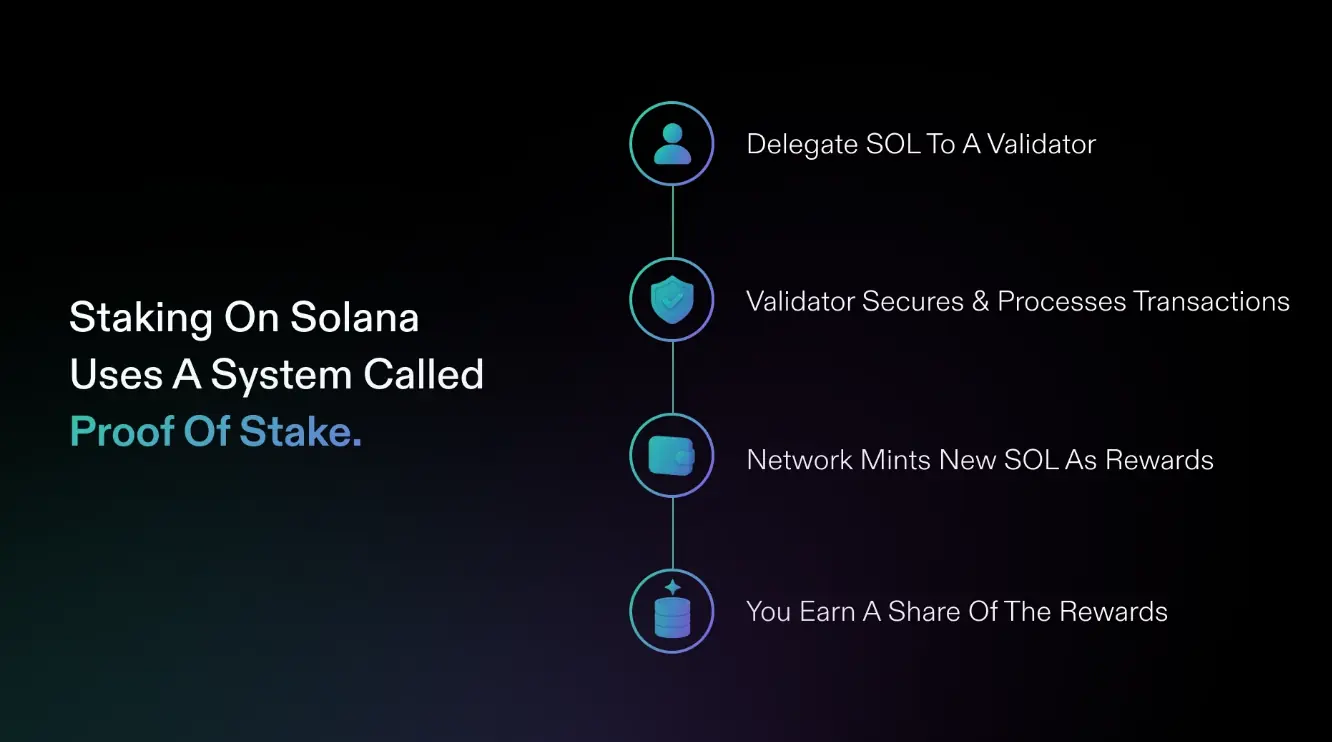
<p>Native staking is the simplest way to earn passive income from your SOL holdings. This works by delegating SOL coins to a validator of your choice, and you receive staking rewards while retaining ownership of your coins.</p>

<figure class="article-figure">
  <img src="/assets/images/solana-native-staking.webp" alt="Solana staking process from delegating SOL to earning validator rewards" width="1332" height="742" loading="lazy" decoding="async" />
  <figcaption>Solana staking | Solana</figcaption>
</figure>

<h3 id="solana-native-staking-explained">Solana native staking explained</h3>

<p>Solana validators earn SOL through inflation when new coins are issued, by collecting priority fees when users pay extra to have their transactions land first, and via MEV rewards (Maximal Extractable Value) when users tip validators to include transaction bundles.</p>

<p>To earn staking rewards, validators must vote correctly on blocks that become part of the chain. Validators who fail to vote on time or experience downtime may not earn enough SOL for their stakers. That’s why it’s important to stake your coins with reputable validators that avoid such issues. Some of the best places to stake SOL include Jito, Jupiter, Marinade, Helius, and even exchange validators like Kraken and Coinbase.</p>

<h3 id="rewards-and-unstaking">Rewards and unstaking</h3>

<p>As of August 12, 2026, native <a href="https://www.helius.dev/staking/rewards">SOL staking rewards range from</a> 4.84% to 5.38%, depending on the validator’s performance and on-chain activity. This means that staking 100 SOL can earn up to 5.38 SOL in staking rewards over 12 months at a rate of 5.38%. Earned yield is paid every Solana epoch, which is about two days, and accrues in your staking account.</p>

<p>When you no longer wish to stake, you can unstake. Typically, it takes two days for your funds to be unlocked and ready to use again. Because the SOL you staked is yours, it doesn’t depend on liquidity. It simply returns to your wallet account after one Solana epoch has ended.</p>

<h3 id="risks-of-native-sol-staking">Risks of native SOL staking</h3>

<p>As with any Solana passive income option, there are risks to staking SOL natively. The main risk is SOL price volatility. If you buy SOL at $150 and it drops to $50, you lose 66% on paper. As long as you don’t sell and SOL’s price recovers, you will ultimately end up with more SOL in your wallet, and it will be worth more than when you started.</p>

<p>Additionally, there’s validator risk if you stake with a validator that fails to stay online and vote on time. You won’t lose your staked SOL, but you also won’t earn yield. Fortunately, this isn’t an issue with the top Solana validators.</p>

<h3 id="verdict">Verdict</h3>

<p>Solana investors who plan to hold their SOL coins long-term will find that staking natively is the best way to earn passive income. With around 4.8% APY accrued every Solana epoch and no risk of losing your staked coins, it offers a stable yield.</p>

<p>The main risk with this option is the price volatility of your SOL, which could lose value during typical bear markets.</p>

<aside class="article-callout article-callout--important" aria-label="Important">

  <h3 id="how-to-stake-sol-natively">How to stake SOL natively</h3>

  <p>Assuming you already have a Solana wallet loaded with SOL, all you need to do is:</p>

  <ol>
    <li>
      <p><strong>Choose a validator.</strong> If you’re using Phantom, Backpack, or Solflare wallets, select your SOL and choose the Stake option. Other validators have dedicated webpages for staking.</p>
    </li>
    <li>
      <p><strong>Enter the amount of SOL</strong> you wish to stake.</p>
    </li>
    <li>
      <p><strong>Confirm the transaction</strong> and watch your SOL grow.</p>
    </li>
  </ol>

  <p>Leading Solana validators include: <a href="https://jup.ag/stake">Jupiter</a>, <a href="https://app.marinade.finance/earn/sol/">Marinade</a>, <a href="https://www.helius.dev/stake">Helius</a>, the wallet validators Phantom, Backpack, and Solflare, and exchange validators like Coinbase and Kraken.</p>

</aside>

<h2 id="2-liquid-staking-best-for-keeping-your-sol-liquid">2. Liquid staking: Best for keeping your SOL liquid</h2>

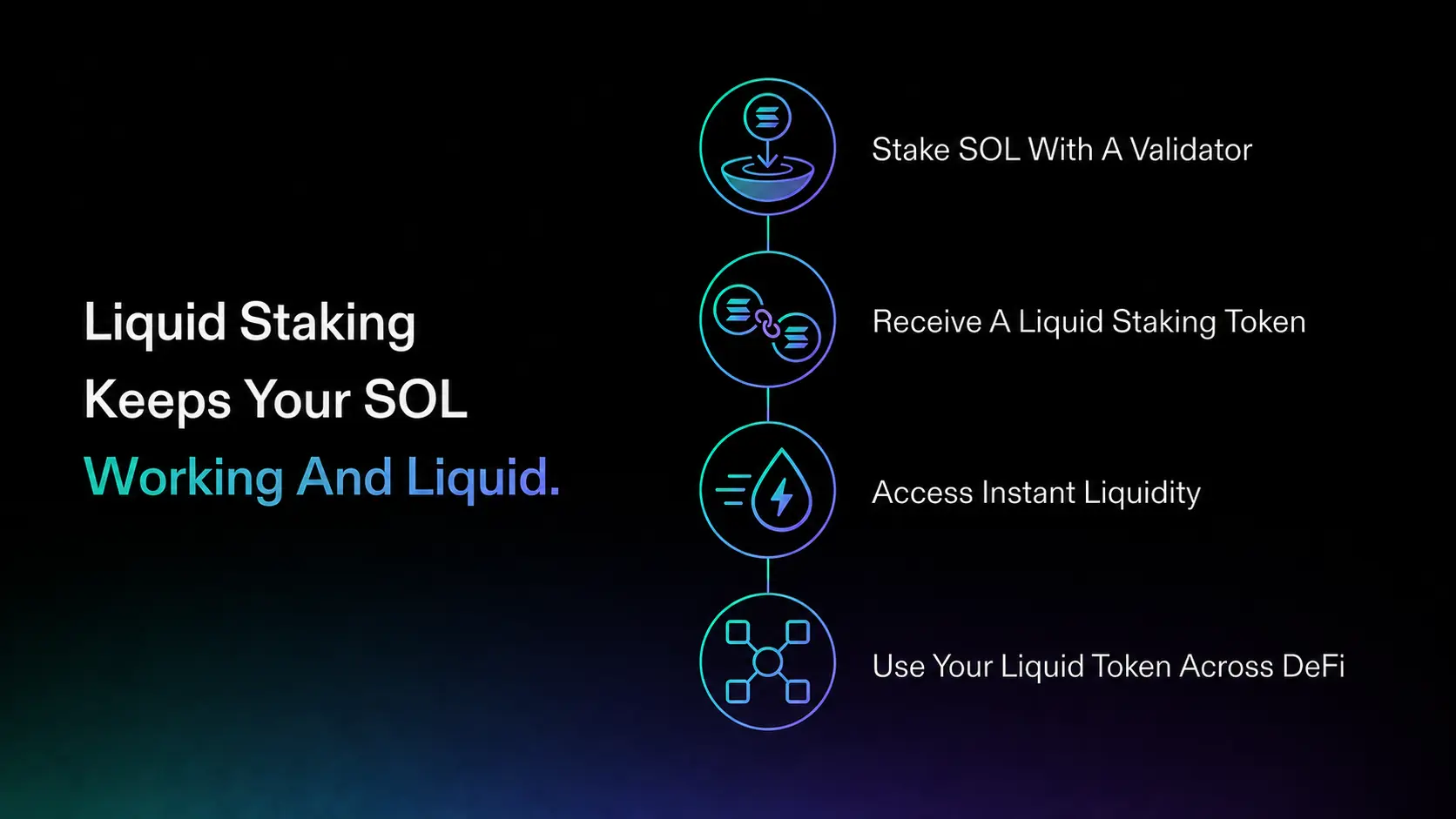
<p>Liquid staking is similar to native SOL staking, with one major difference: you can continue using your coins on DeFi platforms while they are staked. This is an excellent option for those who want to keep their SOL liquid and earn passive yield at the same time.</p>

<figure class="article-figure">
  <img src="/assets/images/solana-liquid-staking.webp" alt="Liquid staking process showing SOL staked for a liquid staking token that remains usable in DeFi" width="1672" height="941" loading="lazy" decoding="async" />
  <figcaption>Solana liquid staking</figcaption>
</figure>

<h3 id="solana-liquid-staking-explained">Solana liquid staking explained</h3>

<p>Some Solana validators allow you to stake your SOL coins with them natively and receive liquid staking tokens (LSTs) in return. As with native staking, the yield earned by the validator is passed to the LST holder.</p>

<p>Because the staking yield is automatically reinvested in the staking pool, the LST always has a higher value than SOL. For example, if you want to exchange your jupSOL for SOL, 1 jupSOL is worth 1.19 SOL now, but in two years it could be 1.40 as the value accrual grows. So the LST formula would be:</p>

<p>1 LST = 1 SOL + interest accrued over time</p>

<p>Liquid staking tokens have a different name, depending on who issued them: JitoSOL, jupSOL, hSOL, mSOL, etc.</p>

<h3 id="rewards-and-unstaking-1">Rewards and unstaking</h3>

<p>As mentioned before, the APY you earn by holding LSTs is nearly the same as staking SOL natively. The main benefit of holding LSTs is liquidity, which lets you use them across DeFi apps like Kamino and Jupiter.</p>

<p>If you need instant cash but don’t want to sell your LST, simply provide it as collateral on Kamino or Jupiter Lend to borrow stablecoins against it.</p>

<p>Those willing to take on higher risk could use looping strategies with multiply. These are automated strategies that borrow SOL against your LST, use the funds to buy more LST, and then borrow more SOL, repeating the process. Yields on such strategies could reach up to 20% APY with various token incentives, which certainly seems more enticing than the 5% staking yield. However, it comes with added risk, and the extra yield may not be worth it for every investor.</p>

<p>Unlike native staking, which requires two days for the Solana epoch to end before you can claim your SOL, with liquid staking you simply swap it to SOL or any other token on the Jupiter DEX or any other DEX on Solana, and you’ve exited your position instantly.</p>

<h3 id="risks-of-liquid-sol-staking">Risks of liquid SOL staking</h3>

<p>While liquid staking is highly secure, with the smart contract <a href="https://www.solana-program.com/docs/stake-pool#security-audits">audited by multiple security firms</a>, there is still a risk it could be exploited. This risk comes in addition to SOL price volatility, which is inherent in SOL staking.</p>

<h3 id="verdict-1">Verdict</h3>

<p>Investors looking to use their staked SOL in DeFi while still earning yield will find liquid staking an excellent Solana passive-income option. Passive LST yield is reinvested within the token, giving it a higher nominal value than SOL.</p>

<p>As with native staking, SOL price volatility is the main risk, with a smaller risk of a smart contract exploit.</p>

<aside class="article-callout article-callout--important" aria-label="Important">

  <h3 id="how-to-get-liquid-sol-tokens">How to get liquid SOL tokens</h3>

  <p>The process is straightforward:</p>

  <ol>
    <li>
      <p><strong>Visit a DEX.</strong> Go to Jupiter Swap or open your crypto wallet and select swap.</p>
    </li>
    <li>
      <p><strong>Find the LST</strong> you want to buy.</p>
    </li>
    <li>
      <p><strong>Select the amount</strong> of SOL or USDC you want to trade for the LST.</p>
    </li>
    <li>
      <p><strong>Review the details</strong> and confirm the transaction.</p>
    </li>
  </ol>

  <p>Popular LSTs on Solana are INF, JitoSol, jupSOL, hSOL, mSOL, bonkSOL, and bSOL.</p>

</aside>

<h2 id="3-holding-jlp-best-for-earning-jupiter-perps-fees">3. Holding JLP: Best for earning Jupiter Perps fees</h2>

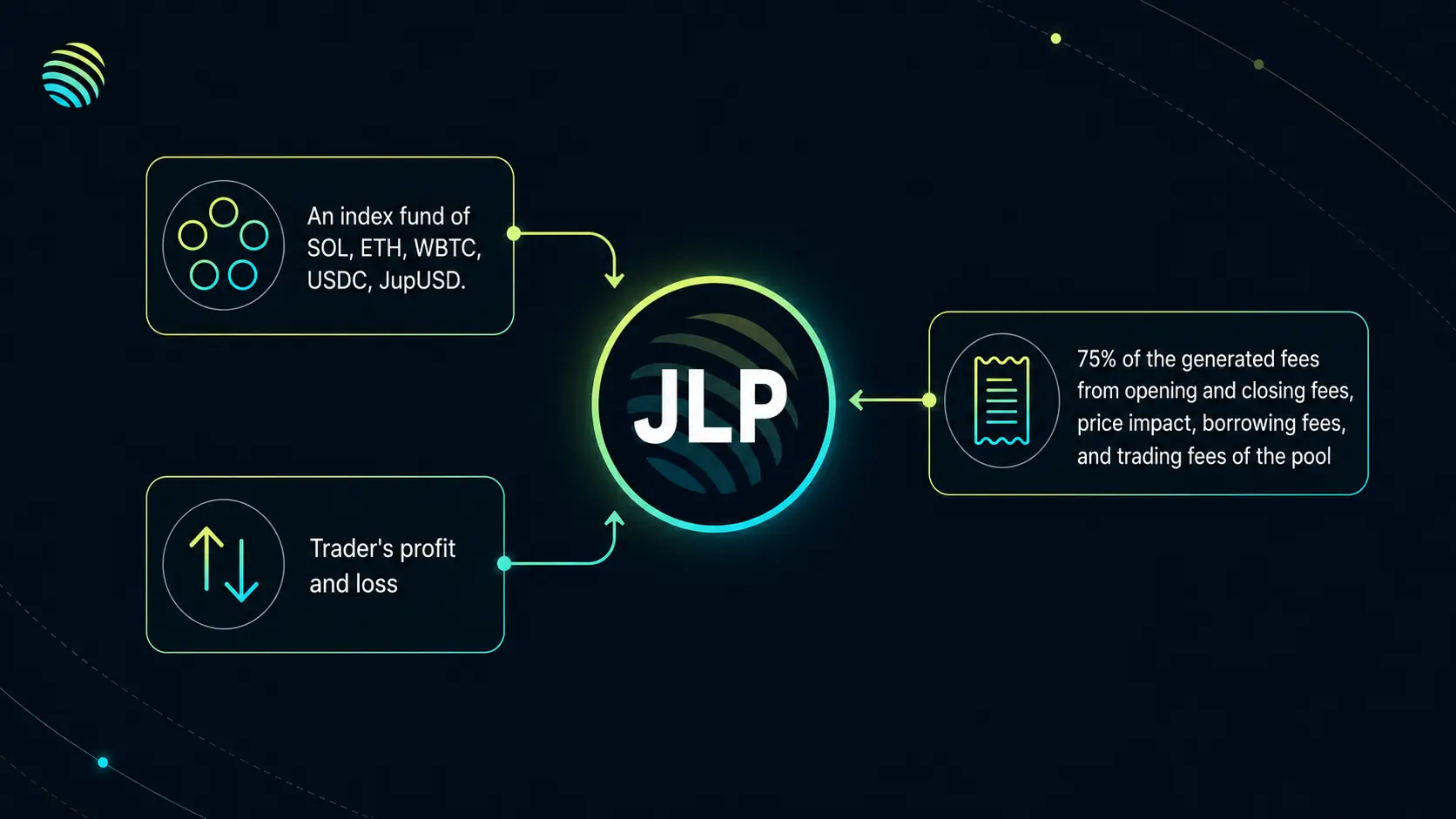
<p>As the name suggests, JLP (Jupiter Liquidity Provider) is the liquidity-providing token for Jupiter Perps. It represents a basket of SOL, ETH, wBTC, and stablecoins and serves as the counterparty to traders on Jupiter’s perpetual futures platform. JLP token holders earn 75% of the Jupiter Perps fees, which are automatically reflected in the token’s price.</p>

<figure class="article-figure">
  <img src="/assets/images/jlp-yield-explained.webp" alt="JLP yield diagram showing its asset basket, trader profit and loss, and Jupiter Perps fees" width="1672" height="941" loading="lazy" decoding="async" />
  <figcaption>Jupiter Liquidity Provider (JLP) token</figcaption>
</figure>

<h3 id="jlp-explained">JLP explained</h3>

<p>Jupiter Perps is the strongest Jupiter product and generates the most revenue, <a href="https://defillama.com/protocol/fees/jupiter">according to DefiLlama</a>. From Q1 2025 to Q3 2026, Jupiter Perps generated over $130 million in fee revenue. These figures are significant in the crypto space, given that many projects are unprofitable.</p>

<p>The JLP token itself has two main functions:</p>

<ol>
  <li>
    <p><strong>Provides liquidity</strong> and serves as the counterparty to Jupiter Perps traders. When traders lose money, the losses benefit the JLP pool, and vice versa.</p>
  </li>
  <li>
    <p><strong>Receives 75% of the fees</strong> generated by the platform.</p>
  </li>
</ol>

<p>There is no staking with JLP, so you simply buy and hold the token. The more Jupiter Perps generate fees, the higher the value of JLP.</p>

<p>Holding JLP can be considered a passive income strategy because Perps fees compound automatically without active position management. However, JLP isn’t a low-volatility income product.</p>

<p>Its price moves with the underlying cryptoassets and with the profits or losses generated by Jupiter Perps traders. This makes it a solid product to accumulate during bear markets, when the prices of BTC, SOL, and ETH are low and perpetual futures activity is low, resulting in an attractive JLP price.</p>

<p>As of July 2026, <a href="https://jup.ag/perps/jlp-earn">JLP had over $800 million</a> in total value locked, with 46% of that amount being in SOL.</p>

<h3 id="jlp-rewards">JLP rewards</h3>

<p>The “rewards” of holding JLP are twofold: one is JLP price appreciation driven by the appreciation of the underlying assets in the pool (SOL, ETH, and BTC); another is JLP’s variable percentage yield, calculated from fees generated by Jupiter Perps and updated every seven days.</p>

<p>This means you don’t receive extra tokens; the yield is reflected in the JLP price.</p>

<h3 id="can-i-sell-jlp-whenever-i-want">Can I sell JLP whenever I want?</h3>

<p>Yes. JLP is just another token on the Solana blockchain, so you can open Jupiter Swap and sell your JLP for any other token or stablecoin to close the position.</p>

<aside class="article-callout article-callout--important" aria-label="Important">

  <h3 id="advanced-jlp-strategy">Advanced JLP strategy</h3>

  <p>Investors can increase their JLP exposure by using the token as collateral to borrow USDC and buy more JLP. These tokens are locked again to borrow more USDC and repeat the process.</p>

  <p>This is called “looping”, and you can do it manually or use Kamino or Jupiter Lend’s multiply strategies for automatic looping.</p>

  <figure class="article-figure article-figure-wide">
  <img src="/assets/images/jupiter-lend-jlp-multiply.webp" alt="Jupiter Lend JLP multiply interface showing leverage, supply APY, borrow APY, and health status" width="2048" height="1004" loading="lazy" decoding="async" />
  <figcaption>Jupiter Lend JLP multiply | Jupiter</figcaption>
</figure>

  <p>JLP looping can significantly increase returns when JLP outperforms the cost of borrowing USDC, but it can also amplify losses and introduce liquidation risk if used with maximum leverage. This isn’t a set-and-forget passive-income strategy.</p>

  <p>Your return broadly depends on:</p>

  <p class="article-formula">Net return ≈ (JLP return×leverage) − (USDC borrow APY×(leverage−1))</p>

  <p>Both sides of the calculations are variable.</p>

  <h4 id="jupiter-lend-vs-kamino-for-jlp-leverage">Jupiter Lend vs Kamino for JLP leverage</h4>

  <p>Jupiter Lend and Kamino offer JLP looping strategies. Here’s how they compare:</p>

  <table>
    <thead>
      <tr>
        <th><strong>Feature</strong></th>
        <th>Jupiter Lend</th>
        <th>Kamino Multiply</th>
      </tr>
    </thead>
    <tbody>
      <tr>
        <td>Underlying JLP APY</td>
        <td>6.17% variable</td>
        <td>6.17% variable</td>
      </tr>
      <tr>
        <td>USDC borrowing APY</td>
        <td>4.83% variable</td>
        <td>4.07% variable</td>
      </tr>
      <tr>
        <td>Maximum leverage</td>
        <td>6.4x</td>
        <td>6.2x</td>
      </tr>
      <tr>
        <td>Liquidation threshold</td>
        <td>90%</td>
        <td>85%</td>
      </tr>
      <tr>
        <td>Liquidation approach</td>
        <td>Standard leveraged-position risk</td>
        <td>Softer liquidations with lower starting penalties</td>
      </tr>
      <tr>
        <td>Main advantage</td>
        <td>Lower borrowing cost and more attractive parameters</td>
        <td>Longer operating history and softer liquidation design</td>
      </tr>
    </tbody>
  </table>

  <p>These figures were checked on August 12, 2026, and can change with JLP performance, USDC borrowing demand, and protocol risk setting.</p>

  <h4 id="which-is-better-for-jlp-looping-jupiter-lend-or-kamino">Which is better for JLP looping: Jupiter Lend or Kamino?</h4>

  <p>Jupiter Lend currently appears more attractive on paper because it has a lower USDC borrowing rate, slightly higher maximum leverage, and a higher liquidation threshold. Kamino has a longer operating history and uses softer liquidations with lower starting penalties, which may reduce damage from a liquidated position.</p>

  <p><strong>Warning:</strong> Using the JLP looping strategy uses leverage and can liquidate your position if you use maximum leverage and the price of JLP drops.</p>

</aside>

<h3 id="risks-of-jlp">Risks of JLP</h3>

<p>The price of JLP directly depends on the prices of SOL, ETH, and BTC. If these assets drop in value, the price of JLP will follow. Additionally, JLP takes 75% of the Jupiter Perps fees. If this product earns less, the JLP price will reflect that with a lower percentage yield.</p>

<p>Another type of risk is smart contract and platform risk, which could occur regardless of how thoroughly Jupiter’s products are audited.</p>

<h3 id="verdict-2">Verdict</h3>

<p>JLP is a passive-income strategy that automatically compounds Jupiter Perps fee income without borrowing or liquidation risk, making it a solid option for investors who want to diversify their crypto exposure.</p>

<p>JLP captures 75% of the Jupiter Perps fees, which makes it a strong and profitable product. Additionally, JLP’s price is affected by SOL, ETH, and BTC prices, as they are held within the Perps liquidity pool.</p>

<aside class="article-callout article-callout--important" aria-label="Important">

  <h3 id="how-to-get-jlp-tokens">How to get JLP tokens</h3>

  <p>As with any Solana token, the process goes like this:</p>

  <ol>
    <li>
      <p><strong>Visit a DEX.</strong> Go to Jupiter Swap or open your crypto wallet and select swap.</p>
    </li>
    <li>
      <p><strong>Find the JLP</strong> token in the list of tokens you wish to buy.</p>
    </li>
    <li>
      <p><strong>Select the amount</strong> of SOL or USDC you wish to trade for JLP.</p>
    </li>
    <li>
      <p><strong>Check the details</strong> and confirm the transaction.</p>
    </li>
  </ol>

  <p><strong>JLP token contract address:</strong> 27G8MtK7VtTcCHkpASjSDdkWWYfoqT6ggEuKidVJidD4</p>

</aside>

<h2 id="4-juiced-best-liquid-yield-bearing-stablecoin">4. JUICED: Best liquid yield-bearing stablecoin</h2>

<p>Similar to SOL liquid staking tokens, Jupiter has introduced a liquid staking stablecoin called JUICED. Currently, JUICED offers the highest stablecoin yield for passive income simply by holding it in your wallet.</p>

<figure class="article-figure">
  <img src="/assets/images/juiced-yield-explained.webp" alt="JUICED yield diagram showing JupUSD borrowing interest and Treasury-bill reserve yield accruing into the token price" width="1672" height="941" loading="lazy" decoding="async" />
  <figcaption>JUICED</figcaption>
</figure>

<h3 id="juiced-explained">JUICED explained</h3>

<p>Jupiter has its own stablecoin, JupUSD, backed 90% by USDtb (Ethena’s treasury-backed stablecoin collateralized by BlackRock’s BUIDL tokenized US Treasury fund) and 10% by USDC held in decentralized pools to ensure instant redemptions and smooth trading.</p>

<p>When users deposit JupUSD into Jupiter Earn to earn passive APY, they receive JUICED tokens in return that represent the locked JupUSD. This means there’s no leverage and no liquidation risk. Additionally, you can supply JUICED as collateral and borrow against it while still earning interest on your holdings.</p>

<h3 id="rewards">Rewards</h3>

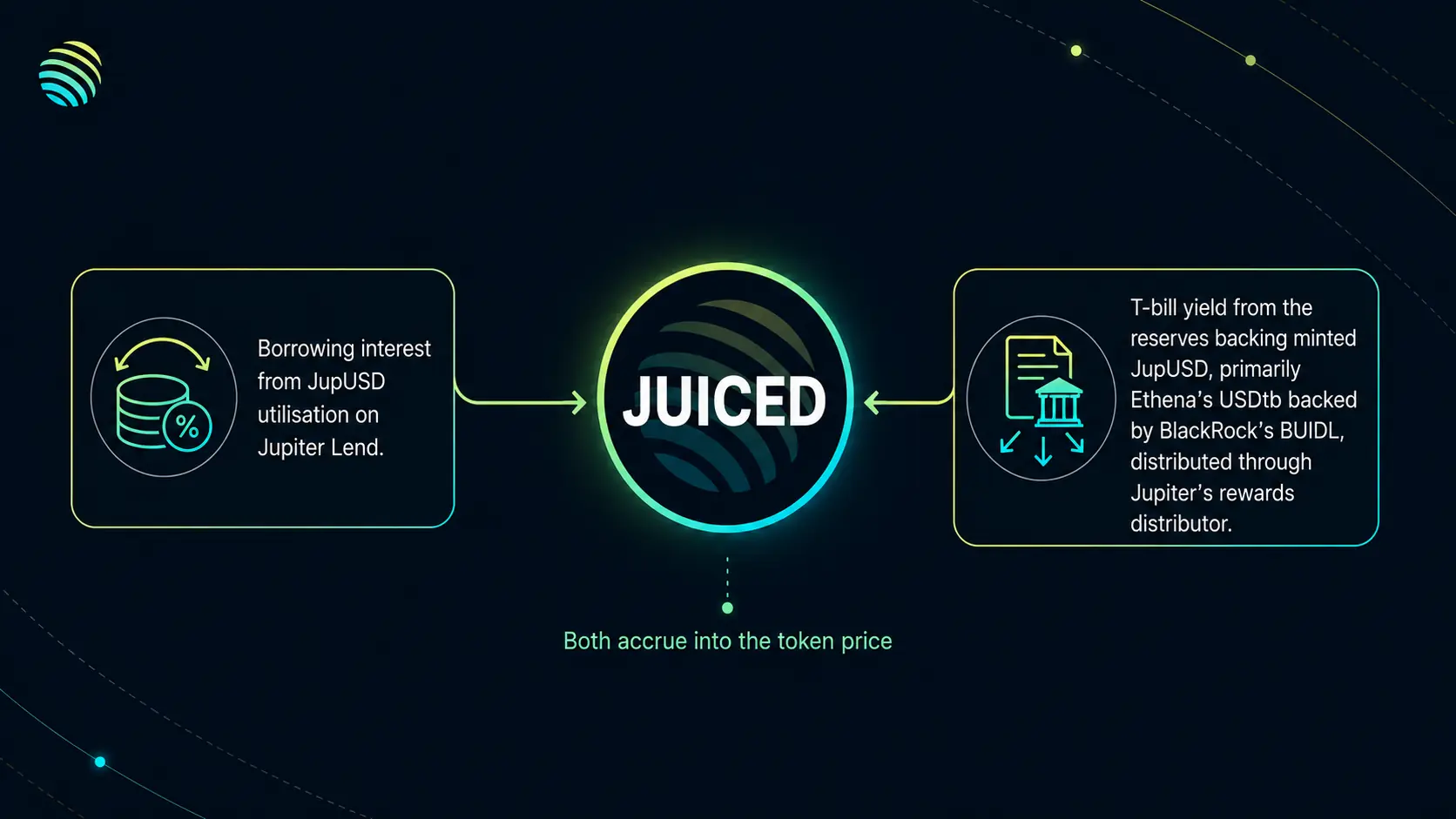
<p>JUICED earns from two sources:</p>

<ul>
  <li>
    <p><strong>Borrowing interest.</strong> Users who borrow JupUSD through Jupiter Lend pay interest.</p>
  </li>
  <li>
    <p><strong>Reserve yield.</strong> The assets backing JupUSD generate US Treasury-bill income, which is distributed to JUICED holders.</p>
  </li>
</ul>

<p>Other stablecoins like USDT keep their Treasury yield as revenue, while USDC’s Circle shares its revenue with Coinbase. Because JupUSD distributes its reserve yield to holders, it can offer a much higher yield than USDT and USDC.</p>

<p>JUICED holders don’t receive additional JUICED tokens as rewards. Instead, each JUICED token increases in value when redeemed for JupUSD or other stablecoins.</p>

<p>For example:</p>

<ol>
  <li>
    <p>You deposit $1,000 in JupUSD.</p>
  </li>
  <li>
    <p>You receive around 1,000 JUICED.</p>
  </li>
  <li>
    <p>If the strategy earns more than 5% within a year, your JUICED could be redeemed for $1,050 JupUSD.</p>
  </li>
</ol>

<p>In essence, the number of your JUICED tokens in your wallet remains the same, but their value has increased based on the APY.</p>

<p>JUICED holders can boost the standard yield with Jupiter’s JUICED/USDT strategy. However, the strategy uses 9x leverage and can increase the JUICED yield from around 5.2% to 10.4%, which may not justify the risk, even if it is small.</p>

<h3 id="can-i-sell-my-juiced-tokens">Can I sell my JUICED tokens?</h3>

<p>Yes. Like any other token on Solana, you can sell your JUICED whenever you want for stablecoins, SOL, or any other token you wish.</p>

<h3 id="risks-of-holding-juiced">Risks of holding JUICED</h3>

<p>While the strategy and backing of JUICED are straightforward and the risk of JupUSD depegging is minimal, there are still risks. Even stablecoins like <a href="https://www.cnbc.com/2023/03/11/stablecoin-usdc-breaks-dollar-peg-after-firm-reveals-it-has-3point3-billion-in-svb-exposure.html">USDC have depegged</a> in the past, even shortly.</p>

<p>Moreover, JUICED relies on Ethena’s USDtb, BlackRock BUIDL, and custody arrangements. If any of them fail, it could affect the JupUSD price.</p>

<p>As with any other blockchain protocol, there are smart contract risks. Frequent audits reduce the risk, but exploits could still occur.</p>

<h3 id="verdict-3">Verdict</h3>

<p>JUICED is the best stablecoin option on Solana for passive income right now because of its high yield, a secure protocol, and simplicity. There’s no leverage, so risk is minimal, making it an ideal option for investors or traders who want to earn yield on their stablecoin capital while waiting for the right moment to deploy it.</p>

<aside class="article-callout article-callout--important" aria-label="Important">

  <h3 id="how-to-get-juiced-tokens">How to get JUICED tokens</h3>

  <p>There are two ways to get JUICED:</p>

  <ol>
    <li>
      <p><strong>Visit Jupiter Swap</strong> and swap your SOL, USDC, or any other token for JUICED.</p>
    </li>
    <li>
      <p><strong>Visit Jupiter Lend</strong> and deposit JupUSD, which automatically gives you JUICED tokens in your wallet.</p>
    </li>
  </ol>

  <p><strong>JUICED token contract address:</strong> 7GxATsNMnaC88vdwd2t3mwrFuQwwGvmYPrUQ4D6FotXk</p>

</aside>

<h2 id="5-huma-classic-pst-best-high-yield-real-world-strategy">5. Huma Classic PST: Best high-yield real-world strategy</h2>

<p>Huma Classic differs from most yield-bearing strategies on Solana because it’s tokenized private credit, not ordinary stablecoin lending like those on Jupiter or Kamino. As a result, its yield is potentially more durable than temporary incentives, which are common in DeFi. However, this product carries slightly higher risk than other stablecoin lending strategies.</p>

<figure class="article-figure article-figure-portrait">
  <img src="/assets/images/huma-classic.webp" alt="Huma Classic deposit interface showing a six-month USDC strategy" width="1172" height="1081" loading="lazy" decoding="async" />
  <figcaption>Huma Classic | Huma Finance</figcaption>
</figure>

<h3 id="huma-classic-explained">Huma Classic explained</h3>

<p>Huma Classic allows investors to earn USDC yield and HUMA tokens by providing short-term financing to businesses that process real-world payments.</p>

<p>The process is simple: Investors deposit USDC on Huma’s site and receive PST (PayFi Strategy Token), a yield-bearing Solana token that represents their share of Huma’s financing strategy. Huma holds 85% of the assets in its pool for PayFi strategies and 15% in market-neutral liquid assets to ensure liquidity for redemptions.</p>

<p>Payment institutions use Huma’s liquidity to settle transactions without holding large amounts of capital across multiple markets. Businesses typically pay between six and 10 basis points per day and repay the financing within one to five days, <a href="https://blog.huma.finance/introducing-huma-2.0-permissionless-real-yield-on-solana">according to Huma</a>.</p>

<h3 id="rewards-1">Rewards</h3>

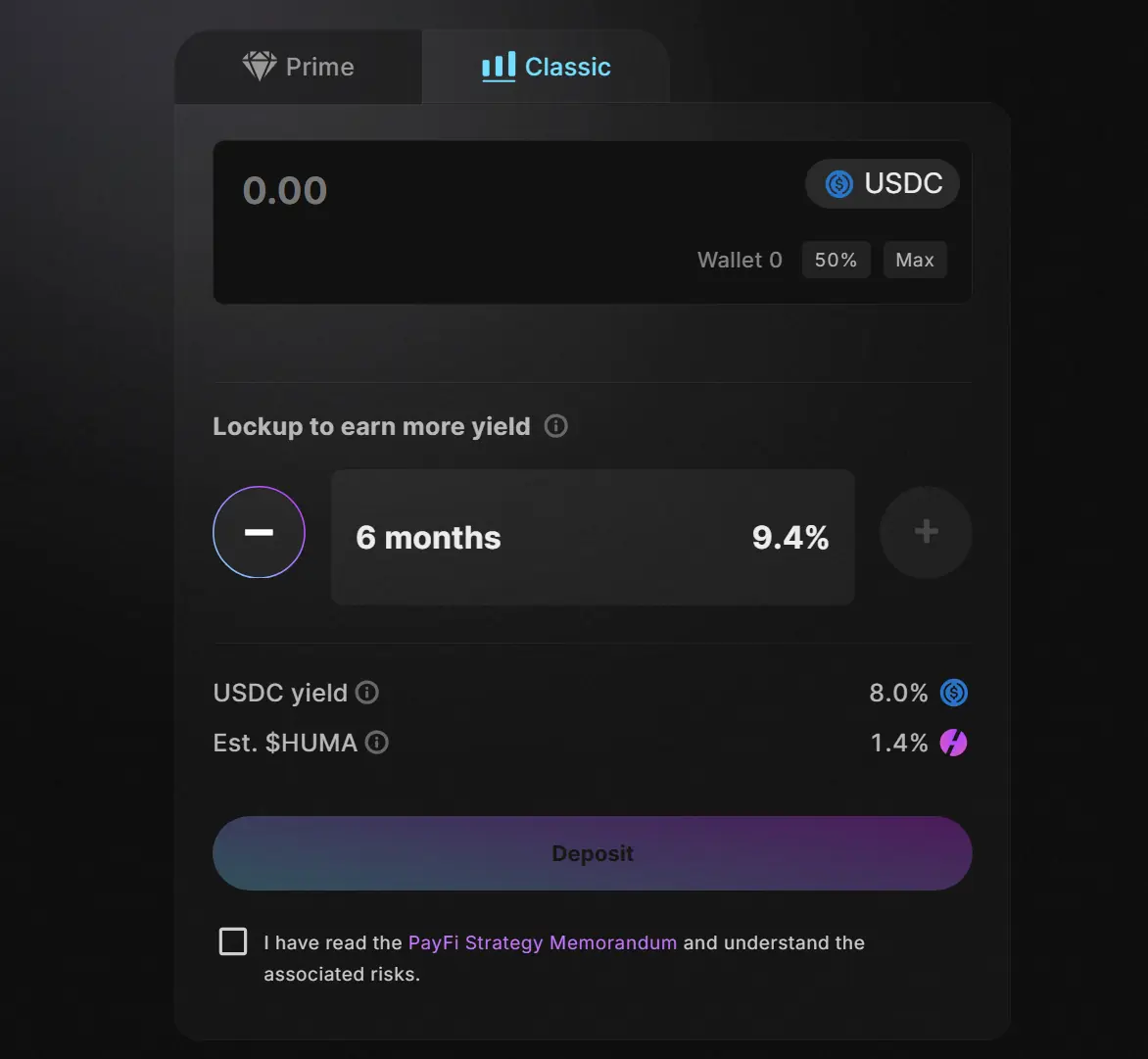
<p>Huma Classic currently offers an APY of 8% in USDC and 1.7% in HUMA tokens, for a combined APY of around 9.7%, making it one of the most rewarding stablecoin yields on Solana. This yield comes with a six-month lock-up period.</p>

<p>Additionally, there’s a three-month lock-up period with a 9% APY (8% USDC and 1% HUMA), and a no-lock-up yield of 8.2% (8% USDC, 0.2% HUMA).</p>

<p>Investors can buy the PST token directly via Jupiter Swap and hold it to gain exposure to Huma Classic. This also works because Huma adds its payment-financing income to the Classic strategy, where the yield belongs to the token. The token itself should gradually increase in value. However, when investors buy PST directly, they forfeit the additional HUMA rewards tied to the wallet that makes the deposit in the Huma Finance app.</p>

<h3 id="can-i-exit-whenever-i-want">Can I exit whenever I want?</h3>

<p>If you hold the PST token, you can swap it via Jupiter Swap or any other Solana DEX for any other token you want.</p>

<p>However, if you deposit directly on the Huma Finance site, there may be a lock-up period. If you withdraw before the period expires, you forfeit your HUMA rewards. Additionally, redemption via the Huma site is processed on a first-come, first-served basis, and most are completed within a day, though in some cases it may take up to seven days.</p>

<p>There’s an instant withdrawal option, but it carries variable fees that depend on the liquidity level in the pool.</p>

<h3 id="risks-of-investing-in-huma-classic-pst">Risks of investing in Huma Classic PST</h3>

<p><a href="https://www.halborn.com/audits/huma-finance/solana-programs-060022">Huma has been audited</a> by multiple security firms, including Spearbit, Halborn, and Certora. The company also follows security best practices, but risks remain, including smart contract, regulatory, liquidity, and credit risks.</p>

<h3 id="verdict-4">Verdict</h3>

<p>Huma Classic PST is one of the best passive income options on Solana, offering high stablecoin yield via real-world borrowing. Compared to options like JUICED, PST comes with slightly higher risk.</p>

<aside class="article-callout article-callout--important" aria-label="Important">

  <h3 id="how-to-invest-in-huma-classic-pst">How to invest in Huma Classic PST</h3>

  <p>Investors can buy PST tokens directly via Jupiter Swap and hold them to gain exposure to the 8% yield. But to get the most out of the yield, you need to deposit USDC directly on the Huma Finance site. Here’s how:</p>

  <ol>
    <li>
      <p><strong>Visit app.huma.finance</strong> and select Classic.</p>
    </li>
    <li>
      <p><strong>Enter the amount of USDC</strong> you want to deposit.</p>
    </li>
    <li>
      <p><strong>Select a duration</strong> of no lock-up, three months, or six months.</p>
    </li>
    <li>
      <p><strong>Confirm the transaction,</strong> then withdraw when the time comes.</p>
    </li>
  </ol>

  <p><strong>PST token contract address:</strong> 59obFNBzyTBGowrkif5uK7ojS58vsuWz3ZCvg6tfZAGw</p>

</aside>

<h2 id="which-solana-passive-income-option-is-best-for-you">Which Solana passive-income option is best for you?</h2>

<p>All five Solana passive-income options are solid, depending on investor goals. These options don’t use leverage, which significantly reduces risk.</p>

<table>
  <thead>
    <tr>
      <th><strong>If you want…</strong></th>
      <th><strong>Most suitable option</strong></th>
    </tr>
  </thead>
  <tbody>
    <tr>
      <td>The simplest way to earn from SOL</td>
      <td>Native staking</td>
    </tr>
    <tr>
      <td>Staking yield while keeping SOL liquid</td>
      <td>LST tokens like JitoSol, jupSOL, hSOL, bSOL, INF, etc.</td>
    </tr>
    <tr>
      <td>To grab 75% of Jupiter Perps fee revenue and get broad exposure to SOL, ETH, and BTC</td>
      <td>JLP</td>
    </tr>
    <tr>
      <td>High stablecoin yield while keeping funds liquid</td>
      <td>JUICED</td>
    </tr>
    <tr>
      <td>Highest stablecoin yield with credit risk</td>
      <td>Huma Classic PST</td>
    </tr>
  </tbody>
</table>

<h3 id="strategies-that-did-not-make-the-top-five">Strategies that did not make the top five</h3>

<p>I evaluated several passive-income options on Solana for this article, and there were two promising candidates. Unfortunately, neither made the cut.</p>

<ul>
  <li>
    <p><strong>Steakhouse USDG high-yield strategy</strong> on Kamino offers the highest stablecoin yield, over 9%. However, the yield was subsidized for three months. For those looking for a quick boost in yield, it would be a decent strategy to consider. However, this isn’t passive, as you’d have to monitor when the incentives stop and the yield drops to ~4%.</p>
  </li>
  <li>
    <p><strong>Jupiter Ethena x Bitwise USDG Loop</strong> can get up to 20% APY with a USDe and USDG loop. However, capacity on July 24, 2026 was full. If capacity opens, it could be worth considering, but there’s no information on <em>when</em> or <em>if</em> that will happen.</p>
  </li>
</ul>

<h2 id="risk-of-earning-passive-income-on-solana">Risk of earning passive income on Solana</h2>

<p>While Solana is a secure blockchain and all the protocols listed here have undergone rigorous audits, there are still risks to consider before committing your funds.</p>

<p>The first risk is smart contract exploits. In <a href="https://www.bloomberg.com/news/articles/2026-04-19/crypto-hack-worth-290-million-triggers-defi-contagion-shock">April 2026, hackers drained over $290 million</a> in crypto after exploiting a cross-chain bridge. That same month, <a href="https://www.chainalysis.com/blog/lessons-from-the-drift-hack/">$285 million was drained</a> in a coordinated attack on Solana’s perps exchange, Drift Protocol. All the protocols listed as the top five best passive income options on Solana have been audited by multiple security firms and, over their years of operation, haven’t suffered any exploits. Despite that, there is always a risk that something could happen.</p>

<p>Price volatility is another risk. Assets like SOL and JLP aren’t stable. They fluctuate during the various phases of the bull and bear cycles. The passive income from these assets is paid in the asset itself.</p>

<p>Stablecoins like JUICED carry depeg risk. Even though JUICED is backed by Ethena’s treasury-backed stablecoin, USDtb, which is collateralized by BlackRock’s BUIDL tokenized US Treasury fund, there are no guarantees it will never depeg. However, JUICED is not a leveraged position, so as long as the stablecoin returns to peg, there shouldn’t be any issues.</p>

<p>Huma Classic PST carries credit and liquidity risks. If someone fails to pay off their debt or there isn’t enough liquidity for everyone to cash out, this could be a problem. However, this is a minor risk right now.</p>

<p>Finally, investors themselves can have their wallets hacked and funds drained. It’s important that you never keep your wallet’s seed phrase (private keys) on your computer or take photos of them. Write them on a piece of paper and keep them somewhere safe. As an extra precaution, you can get a hardware wallet, which is a USB-type device that stores the seed phrase offline and encrypted, making it much harder for hackers to steal your funds.</p>

<h2 id="conclusion">Conclusion</h2>

<p>Native SOL staking remains the best default passive-income option on Solana for long-term holders because it offers a straightforward yield without introducing DeFi lending or protocol risk.</p>

<p>Liquid staking is more flexible, while JUICED and Huma Classic serve investors who prefer dollar-denominated income and are willing to accept additional risk. JLP is a solid option for those seeking passive income from a protocol that captures 75% of Jupiter Perps’ fee income.</p>

<p>As with any crypto investment, never invest more than you can afford to lose.</p>

<p>This article is for informational purposes only and is not financial advice.</p>

<h2 id="frequently-asked-questions">Frequently asked questions</h2>

<h3 id="what-is-the-safest-way-to-earn-passive-income-with-sol">What is the safest way to earn passive income with SOL?</h3>

<p>The safest way to earn passive income with SOL is native staking with reputable validators such as Jupiter, Phantom, Helius, Kraken, and Coinbase.</p>

<h3 id="how-much-can-you-earn-by-staking-sol">How much can you earn by staking SOL?</h3>

<p>You can earn around 4.8% as of August 12, 2026.</p>

<h3 id="is-solana-staking-risk-free">Is Solana staking risk-free?</h3>

<p>No. The main risk with Solana native staking is that a validator may not earn rewards due to downtime or failure to vote.</p>

<h3 id="can-you-lose-sol-when-staking">Can you lose SOL when staking?</h3>

<p>No. Your funds are locked with the validator, and you can withdraw whenever you want. However, it takes one Solana epoch (about two days) for your funds to return to your wallet.</p>

<h3 id="can-you-earn-two-yields-by-depositing-jitosol-into-kamino">Can you earn two yields by depositing JitoSOL into Kamino?</h3>

<p>No. The yield shown on the Kamino dashboard includes JitoSOL’s native staking yield.</p>

<h3 id="is-juiced-a-stablecoin">Is JUICED a stablecoin?</h3>

<p>No, JUICED is a liquid staking token for the JupUSD stablecoin. Its value changes over time based on the interest it accrues.</p>

<h3 id="are-solana-passive-income-yields-guaranteed">Are Solana passive-income yields guaranteed?</h3>

<p>No, Solana passive-income yields are variable.</p>

<h3 id="do-you-need-sol-to-pay-transaction-fees">Do you need SOL to pay transaction fees?</h3>

<p>Yes! Keep at least 0.2 SOL in your wallet to ensure smooth transaction execution.</p>

<script type="application/ld+json">
{
  "@context": "https://schema.org",
  "@graph": [
    {
      "@type": "FAQPage",
      "mainEntity": [
        {
          "@type": "Question",
          "name": "What is the safest way to earn passive income with SOL?",
          "acceptedAnswer": {
            "@type": "Answer",
            "text": "The safest way to earn passive income with SOL is native staking with reputable validators such as Jupiter, Phantom, Helius, Kraken, and Coinbase."
          }
        },
        {
          "@type": "Question",
          "name": "How much can you earn by staking SOL?",
          "acceptedAnswer": {
            "@type": "Answer",
            "text": "You can earn around 4.8% as of August 12, 2026."
          }
        },
        {
          "@type": "Question",
          "name": "Is Solana staking risk-free?",
          "acceptedAnswer": {
            "@type": "Answer",
            "text": "No. The main risk with Solana native staking is that a validator may not earn rewards due to downtime or failure to vote."
          }
        },
        {
          "@type": "Question",
          "name": "Can you lose SOL when staking?",
          "acceptedAnswer": {
            "@type": "Answer",
            "text": "No. Your funds are locked with the validator, and you can withdraw whenever you want. However, it takes one Solana epoch (about two days) for your funds to return to your wallet."
          }
        },
        {
          "@type": "Question",
          "name": "Can you earn two yields by depositing JitoSOL into Kamino?",
          "acceptedAnswer": {
            "@type": "Answer",
            "text": "No. The yield shown on the Kamino dashboard includes JitoSOL's native staking yield."
          }
        },
        {
          "@type": "Question",
          "name": "Is JUICED a stablecoin?",
          "acceptedAnswer": {
            "@type": "Answer",
            "text": "No, JUICED is a liquid staking token for the JupUSD stablecoin. Its value changes over time based on the interest it accrues."
          }
        },
        {
          "@type": "Question",
          "name": "Are Solana passive-income yields guaranteed?",
          "acceptedAnswer": {
            "@type": "Answer",
            "text": "No, Solana passive-income yields are variable."
          }
        },
        {
          "@type": "Question",
          "name": "Do you need SOL to pay transaction fees?",
          "acceptedAnswer": {
            "@type": "Answer",
            "text": "Yes! Keep at least 0.2 SOL in your wallet to ensure smooth transaction execution."
          }
        }
      ]
    }
  ]
}
</script>]]></content><author><name>Kliment Dukovski</name></author><category term="Solana" /><category term="Solana passive income" /><category term="SOL staking" /><category term="Liquid staking" /><category term="JLP" /><category term="Jupiter" /><category term="JUICED" /><category term="Huma" /><summary type="html"><![CDATA[Compare the top five passive income options on Solana, including SOL staking and stablecoin lending, with yields and risks explained.]]></summary><media:thumbnail xmlns:media="http://search.yahoo.com/mrss/" url="https://klimentdukovski.com/assets/images/solana-passive-income.webp" /><media:content medium="image" url="https://klimentdukovski.com/assets/images/solana-passive-income.webp" xmlns:media="http://search.yahoo.com/mrss/" /></entry><entry><title type="html">Unicorn of the Next Crypto Cycle: Is This the Best Altcoin to Buy?</title><link href="https://klimentdukovski.com/articles/jupiter-jup-best-altcoin-next-crypto-cycle/" rel="alternate" type="text/html" title="Unicorn of the Next Crypto Cycle: Is This the Best Altcoin to Buy?" /><published>2026-07-20T00:00:00+00:00</published><updated>2026-07-20T00:00:00+00:00</updated><id>https://klimentdukovski.com/articles/jupiter-jup-best-altcoin-next-crypto-cycle</id><content type="html" xml:base="https://klimentdukovski.com/articles/jupiter-jup-best-altcoin-next-crypto-cycle/"><![CDATA[<p>Most beginner investors will recognize Ethereum, Cardano, or XRP as the top altcoins to invest in, while those deep into crypto would choose Hyperliquid, Chainlink, and Solana. In the long run, these are probably decent options, especially the last three.</p>

<p>But lesser-known projects have the potential to outperform these altcoins simply because of their lower market caps, token incentives, and products that solve problems and generate revenue.</p>

<p>One token that could see a massive price surge in the next bull cycle is JUP, Jupiter’s governance token.</p>

<h2 id="jup-overview">JUP Overview</h2>

<ul>
  <li>6.86 billion total token supply</li>
  <li>3.32 billion circulating supply</li>
  <li>1 billion tokens staked in the DAO</li>
  <li>~20% APY for staking JUP</li>
  <li>50% of Jupiter’s fee revenue goes into token buybacks</li>
</ul>

<h2 id="jupiter-the-biggest-planet-in-crypto">Jupiter, the biggest planet in crypto</h2>

<p>Crypto traders and investors who have interacted with the Solana blockchain, whether trading meme coins during the 2024 mania or buying tokenized stocks during the 2025-2026 TradFi bull run, have undoubtedly encountered Jupiter.</p>

<figure class="article-figure">
  <img src="/assets/images/jupiter-swap-interface.png" alt="Jupiter Swap" loading="lazy" />
  <figcaption>Jupiter Swap | Jupiter</figcaption>
</figure>

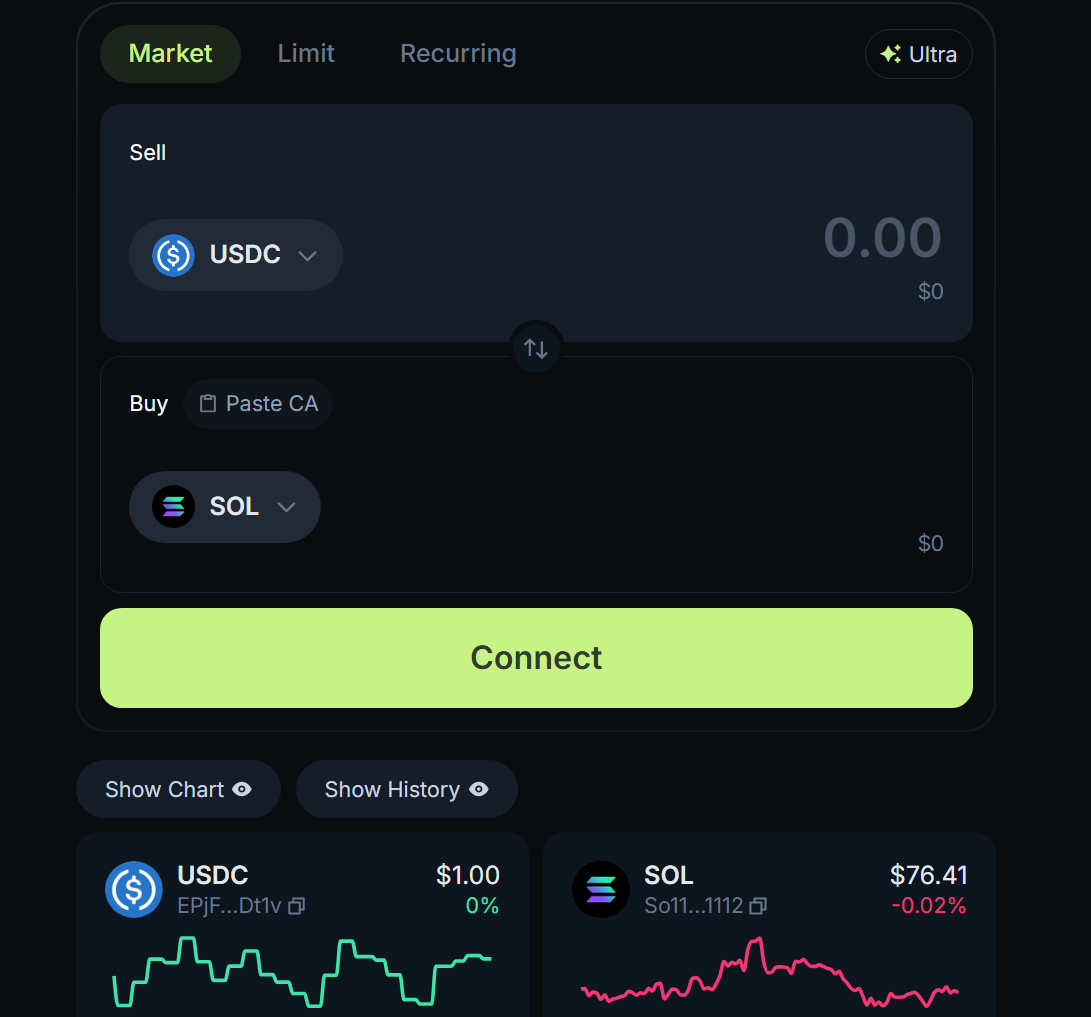
<p>What started as a simple aggregator on Solana in October 2021 has grown into one of the largest crypto projects, with multiple revenue verticals, generating over $1 billion in cumulative fees and over $350 million in cumulative revenue, <a href="https://defillama.com/protocol/jupiter">according to DefiLlama</a>.</p>

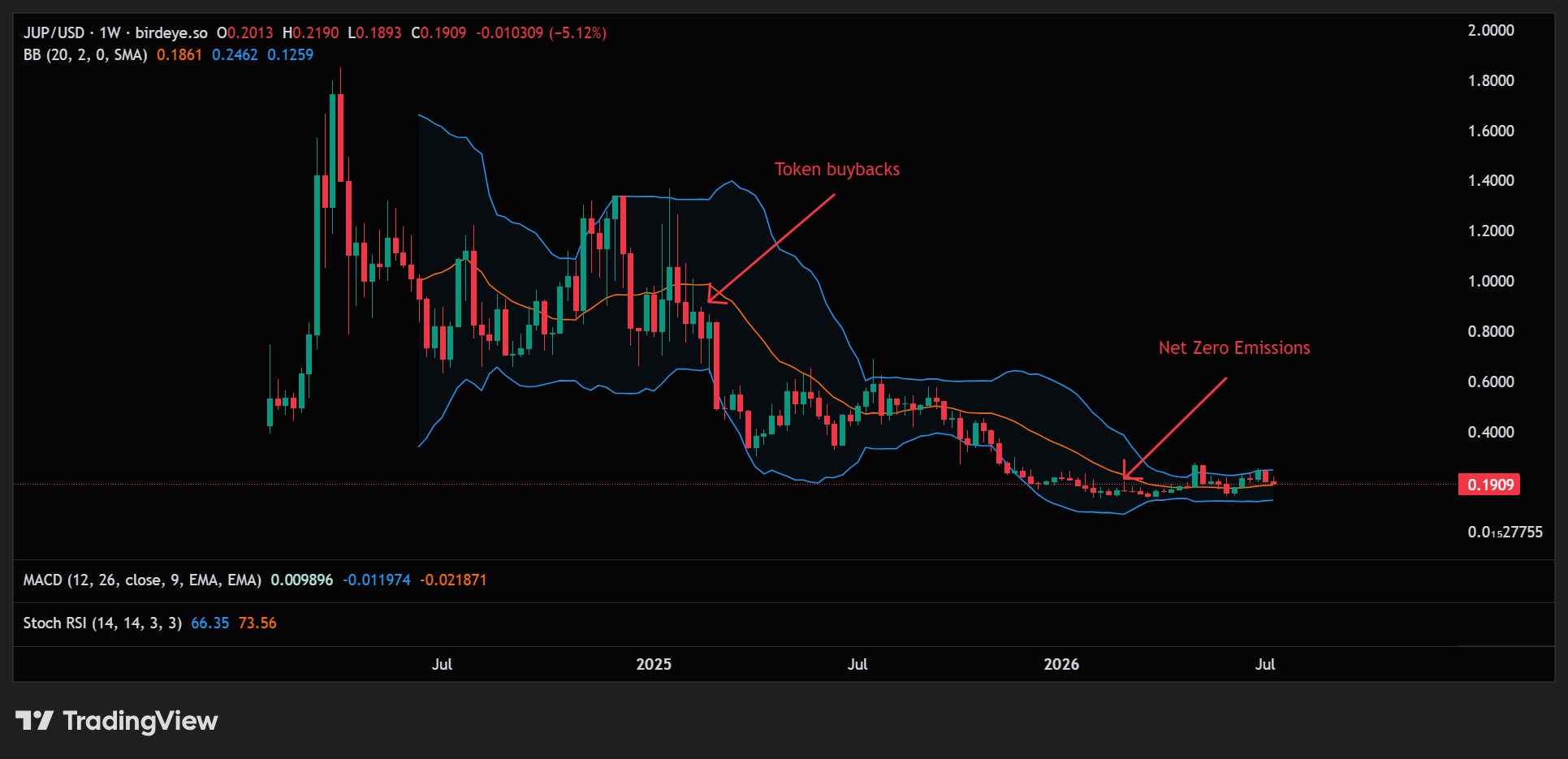
<p>Most crypto projects would pocket the revenue. But Jupiter didn’t. Since February 2025, JUP has been a major beneficiary, with 50% of fee revenue used to buy back the token and remove it from circulation. Over 300 million tokens have been bought so far, with half burned.</p>

<p>Looking at the JUP price chart, however, it seems the buybacks didn’t have any impact on the price, as it continued to drop from $0.87 when the buybacks started to an all-time low of $0.13. The reason for that was high inflation.</p>

<p>Within one year of the buyback program’s start, almost 60% more JUP tokens had been unlocked. The amount of buybacks simply couldn’t absorb the influx of new tokens during a bear market.</p>

<figure class="article-figure">
  <img src="/assets/images/jup-weekly-chart.png" alt="JUP weekly chart" loading="lazy" />
  <figcaption>JUP weekly chart | Birdeye</figcaption>
</figure>

<p>One benefit of being a JUP token holder is the ability to participate in the project’s governance by voting in the DAO. In February 2026, token holders who had locked their JUP voted overwhelmingly in favor of net-zero emissions. Here’s what that means:</p>

<ul>
  <li>Jupuary snapshot taken, but airdrop postponed to a future date</li>
  <li>Team tokens remained locked indefinitely</li>
  <li>Mercurial unlocks offset by Jupiter’s directly buying these tokens</li>
</ul>

<p>Since the vote passed and emissions stopped, JUP stabilized between $0.19 and $0.25, creating a floor that makes buying the token logical for long-term investors at this point.</p>

<p>But for Jupiter to buy back more tokens and push the token price higher, the platform needs to increase its revenue. Fortunately, Jupiter is one of the few crypto projects that have consistently shipped new products.</p>

<p>Recently, it launched <a href="https://x.com/JupiterExchange/status/2076654397237445092?s=20">Jupiter Gacha</a> (powered by Collector Crypt), and in less than a week, over $10 million in Pokémon cards were bought and opened. Before that, Jupiter integrated Polymarket, the largest prediction market, into Solana, enabling users to bet on various events and unlocking another revenue stream.</p>

<p>The biggest bet, however, goes into a project that could revolutionize how investors and traders interact with the blockchain.</p>

<h2 id="global-unified-market">Global Unified Market</h2>

<p>A major issue that has long plagued the crypto space is fragmentation. There are simply too many blockchains that don’t interact well with each other. Investors who want to swap their tokens on the Solana blockchain for tokens on Ethereum will have to either go through a centralized exchange like Kraken or Coinbase and pass an ID verification procedure, or trade wrapped versions of the tokens, which are not always available.</p>

<p>Either option requires financial gymnastics and higher-than-necessary fees, resulting in a poor user experience.</p>

<p>Jupiter has been building their <em>magnum opus</em>, the solution, in silence for the past couple of years. Today, the Global Unified Market (GUM) is in mainnet beta and available for anyone to try. Users can trade crypto seamlessly across multiple blockchains, earn passive income with various yield farming strategies, or trade perps in a completely decentralized and anonymous way.</p>

<figure class="article-figure article-figure-wide">
  <img src="/assets/images/jupiter-global-unified-market.png" alt="Global Unified Market" loading="lazy" />
  <figcaption>Global Unified Market | Jupiter</figcaption>
</figure>

<p>The GUM App lets users access the GUM stack without revealing their identities or having to keep track of seed phrases. The App accepts crypto wallet logins, passkeys, and email addresses. Deposits and withdrawals are made through supported chains without bridging or token claiming, further simplifying access.</p>

<p>Once logged in, users can trade supported assets across multiple chains in one place. Tokenized stocks are also available via xStocks. Professional traders can access orderbook-style perpetual futures with up to 20x leverage, while yield farmers can access passive income strategies via stablecoins and liquid staking tokens.</p>

<p>Granted, GUM is in beta right now. But once it fully launches, it will support a larger number of assets and blockchains, and potentially new features as well.</p>

<h3 id="multiple-revenue-verticals">Multiple revenue verticals</h3>

<p>Jupiter’s swap aggregator remains central to Jupiter and is the second-largest revenue contributor after the perps. But the aggregator has improved significantly over the years.</p>

<p>At the time of writing, Jupiter <a href="https://x.com/JupiterExchange/status/2057037276295864734?s=20">uses Metis V8</a>, the top router with over $2 trillion in lifetime volume. Its main feature is that the executed price is as close as possible to the quoted price you see on your screen. No other competitor comes even close.</p>

<p>Other Jupiter revenue streams include:</p>

<ul>
  <li><strong>Lend.</strong> Jupiter Lend boasts over $2 billion in supplied value across tokens and tokenized stocks. Users can deposit one token, for example, SOL, as collateral to earn APY and borrow another, say USDC. Users can also take advantage of looping and leveraged strategies to boost their passive yield.</li>
  <li><strong>Prediction.</strong> In partnership with Polymarket, users on Solana can predict various events without bridging to Polygon.</li>
  <li><strong>DCA.</strong> Dollar-cost averaging is a popular investment strategy in both crypto and TradFi. Jupiter has made it even more rewarding by adding 4.5% APY while you wait for your DCA to hit. For example, you allocate $10,000 to a DCA and spend $100 per day buying the token you want. Your unused funds accrue 4.5% APY.</li>
  <li><strong>Limit.</strong> Limit orders are best for investors who want to buy a token at a specific price. If the limit order isn’t reached, the transaction won’t execute. To add another twist, Jupiter has integrated trailing stop-loss for Limit orders, so you never round-trip your bags again.</li>
  <li><strong>Offerbook.</strong> This product allows users to deposit any token as collateral and borrow USDC against it. Users set the loan term and APY, making this a useful tool for those who need liquid funds immediately but don’t want to sell their tokens.</li>
</ul>

<h3 id="jupiter-wallet-and-card">Jupiter Wallet and Card</h3>

<p>Jupiter also offers a crypto wallet available as a browser extension and a mobile app. Almost everything available in the Jupiter ecosystem is available within the wallet app, including Limit, DCA, perps, predict, earn, and more.</p>

<figure class="article-figure">
  <img src="/assets/images/jupiter-wallet-app.png" alt="Jupiter Wallet app" loading="lazy" />
  <figcaption>Jupiter Wallet app | Author screenshot</figcaption>
</figure>

<p>While crypto onboarding is seamless and you can buy any token you want directly within the Jupiter wallet using a card, Jupiter offers equally seamless offboarding with its own virtual Visa Card.</p>

<p>The Card is fully integrated within the wallet and allows users to spend their wallet balance wherever Visa is accepted. You only pay 1-1.8% foreign transaction fees. There are no annual fees or other hidden fees. On top of that, there are cashback rewards.</p>

<h2 id="jup-risks">JUP risks</h2>

<p>Jupiter is a solid crypto project with multiple revenue verticals and products that solve user issues. But that doesn’t guarantee the trend will continue. Granted, Jupiter’s swap aggregator dominates the Solana blockchain, and no competitor is even close to replicating its transaction precision, but there are strong competitors on other fronts.</p>

<p>Perps is Jupiter’s biggest revenue contributor, and it’s eclipsed by Hyperliquid. The latter saw <a href="https://www.vaneck.com/pl/en/blog/digital-assets/exploring-hyperliquid-redefining-derivatives-trading/">$633 billion in trading volume</a> in Q1 2026 and is one of the top three crypto protocols by revenue. Other competitors are emerging daily. Phoenix Trade, a perps trading platform, and JTX (from the creators of Jito), a spot trading platform, are already launching strong products that could take market share from Jupiter.</p>

<p>Regulatory and adoption risks are also present. Despite positive moves in the regulatory department, things can change and could negatively affect Jupiter. As for adoption, Jupiter already boasts a strong community that supports the project. But whether that’s enough when projects like GUM leave beta remains to be seen.</p>

<h2 id="final-thoughts">Final thoughts</h2>

<p>Jupiter is the leading Solana swap aggregator, aiming to become the ultimate trading and portfolio app through its Global Unified Market product. With cumulative revenue of over $350 million, it is one of the rare crypto projects that generates revenue. On top of that, 50% of fee revenue goes to JUP buybacks, giving the token constant buy-side pressure.</p>

<p>During the bear market, JUP traded between $0.19 and $0.25, while top altcoins dropped by double digits. When the bull kicks in, Jupiter’s revenue should increase, further boosting the token price. But even if the new bull run is different from the others, with liquidity moving to opening Gacha packs, predicting future events, or simply trading perps, Jupiter is well positioned to take advantage of that.</p>

<p>As with any crypto investment, there are risks, so never invest more than you can afford to lose.</p>

<p>Disclosure: This article is for informational purposes only and does not constitute financial advice.</p>]]></content><author><name>Kliment Dukovski</name></author><category term="Altcoins" /><category term="Jupiter" /><category term="JUP" /><category term="Solana" /><category term="Crypto investing" /><summary type="html"><![CDATA[Most beginner investors will recognize Ethereum, Cardano, or XRP as the top altcoins to invest in, while those deep into crypto would choose Hyperliquid, Chainlink, and Solana. In the long run, these are probably decent options, especially the last three.]]></summary><media:thumbnail xmlns:media="http://search.yahoo.com/mrss/" url="https://klimentdukovski.com/assets/images/jupiter-logo.png" /><media:content medium="image" url="https://klimentdukovski.com/assets/images/jupiter-logo.png" xmlns:media="http://search.yahoo.com/mrss/" /></entry></feed>