
During previous crypto cycles, meme coins had no intrinsic value. They were mostly propped up by community, hype, and perhaps humor. The game in 2026 has changed. We’re now seeing stock-paired meme coins that reward holders with tokenized versions of the underlying stock without staking, looping, or any other action.
However, thousands of meme coins launch daily, making it almost impossible to know which, if any, will win the narrative this cycle. Instead of trying to find the needle in the meme coin haystack, you could play this cycle by investing in the companies that power the infrastructure behind this new meta. This includes meme coin launchpads, liquidity providers and automated market makers (AMMs), tokenized stock issuers, and exchanges.
Ironically, decentralized finance and the move away from traditional finance may prop up traditional stocks too if demand for these stock-paired meme coins increases during this cycle.
Key Takeaways
-
A stock-paired meme coin is launched on a specialized platform such as StonkFun, Pons, or Pump.fun. These platforms earn fees during the launch and thereafter. They use a portion of these fees to buy back their native tokens, STONK, PONS, and PUMP, thereby increasing demand.
-
Newly launched meme coin tokens can have no tax or a transfer tax of up to 3%. Every time a token with a transfer tax is bought, sold, or transferred from a user’s wallet, the tax is deducted from the transfer amount. If the coin creator chooses to, the tax can be used to buy the paired tokenized stock, passively rewarding eligible holders and potentially driving demand for this type of meme coin.
-
Eligible token holders receive tokenized stock based on their holdings, automatically purchased with the token tax. Typically, to receive the reward, you must hold at least $20 of the meme coin. If the value falls below that threshold, meme coin holders receive nothing.
-
Raydium is an AMM that provides liquidity for these meme coins. Users on Meteora and Orca can provide concentrated (CLMM) or dynamic (DLMM) liquidity and earn fees on every swap. Raydium, Meteora, and Orca buy back their RAY, MET, and ORCA tokens with their revenue.
-
Decentralized exchanges (DEXs) like Jupiter earn fees when a trade uses Jupiter’s route. Jupiter also buys back its JUP token using fee revenue.
-
Companies like Ondo and Backpack tokenize stocks and bring them on-chain. However, these two companies don’t buy back tokens, so any benefit to ONDO and BP from this stock-paired meme coin meta would be indirect.
Here’s how the infrastructure companies compare as of October 27, 2026.
| Companies that provide the infrastructure | Token/stock | Token price | Market cap | Token/stock buybacks | Type of infrastructure | 30-day revenue |
|---|---|---|---|---|---|---|
| StonkFun | STONK | $0.1364 | $106.77M | ✅ | Token launchpad | $9.75M |
| Pump.fun | PUMP | $0.00421623 | $1.94B | ✅ | Token launchpad Trading platform |
$63.01M |
| Pons | PONS | $0.2491 | $167.39M | ✅ | Token launchpad Trading platform |
$3.22M |
| Backpack | BP | $0.9395 | $234.90M | X | Tokenizing stocks Exchange |
N/A |
| Ondo | ONDO | $0.4117 | $2.01B | X | Tokenizing stocks | $0.00 |
| Coinbase | COIN | $179.39 (stale) | $47.25B (stale) | ✅ (Corporate allocation decisions) | Tokenizing stocks Exchange |
N/A |
| Robinhood | HOOD | $109.02 (stale) | $99.43B (stale) | ✅(Corporate allocation decisions) | Tokenizing stocks Exchange |
N/A |
| Raydium | RAY | $1.77 | $479.08M | ✅ | AMM Liquidity provider Exchange |
$2.87M |
| Meteora | MET | $0.3210 | $179.51M | ✅ | Liquidity provider | $4.24M |
| Orca | ORCA | $1.66 | $100.90M | ✅ | AMM Liquidity provider Exchange |
$982.94K |
| Jupiter | JUP | $0.2764 | $917.73M | ✅ | Exchange | $4.03M |
What is a stock-paired meme coin?
A stock-paired meme coin is a crypto token whose price is quoted in a stock-linked token rather than SOL or USDC. For example, you have a Super Inu meme coin (SI) launched on StonkFun. SI is paired with NVDAx, the tokenized version of Nvidia.
Although SI is paired with NVDAx in both the initial liquidity pool and the reward mechanism, that doesn’t mean you can only buy SI with NVDAx. You can use SOL or USDC to buy SI, or any other meme coin paired with tokenized stocks. DEXs like Jupiter handle everything in the background, including swapping your SOL or USDC into the quoted tokenized stock to buy the meme coin.
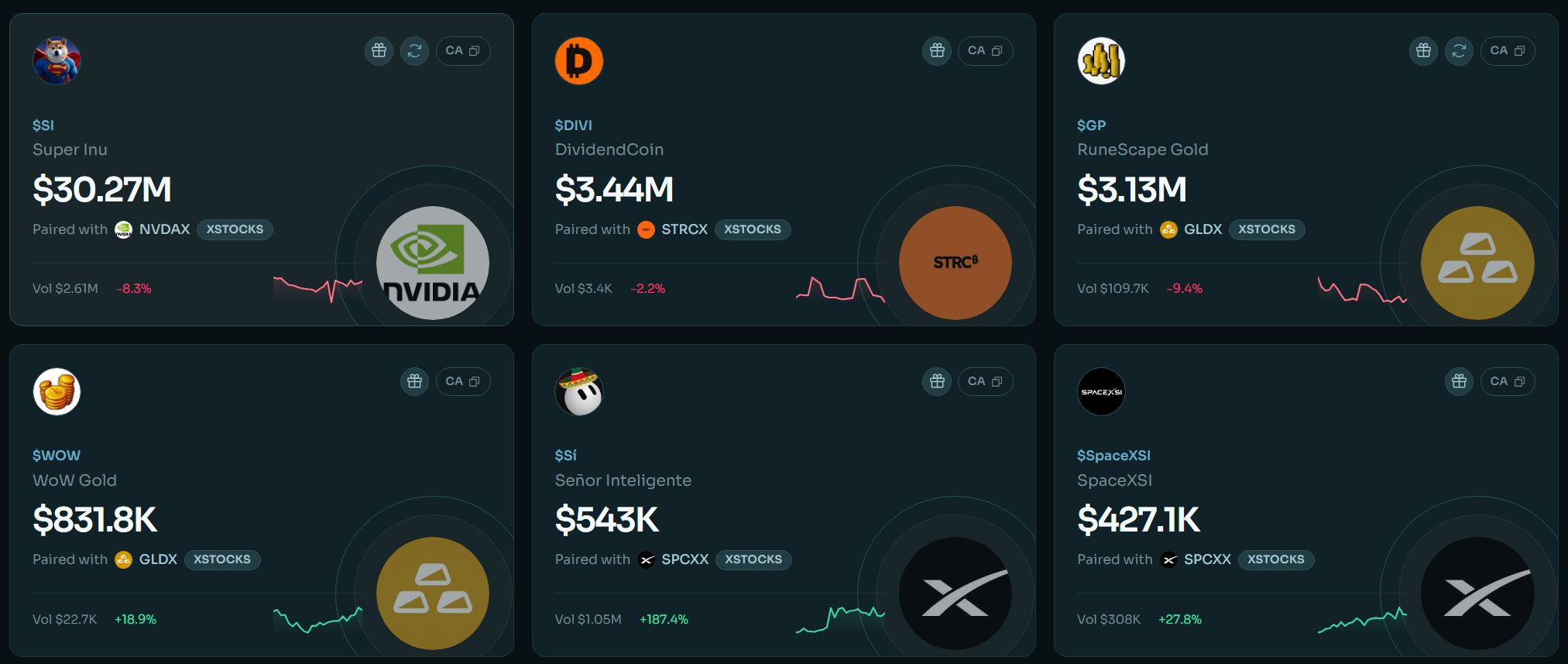
Some of these meme coins can impose a transfer tax of up to 3%. This means that whenever someone buys, sells, or sends the token to another wallet, the tax is deducted from the amount. Sometimes this transfer tax appears as a warning on DEXs, but that’s the feature, not the bug.
The tax is then used to buy the quoted token, such as NVDAx, which is distributed to eligible holders. Meme coins launched on StonkFun typically require a minimum holding of $20 worth of the meme coin to earn the quoted token as a reward. Rewards are distributed in proportion to the holdings. But if the value of the holdings drops under $20, the holder stops getting rewards.
In addition to stocks, meme coins can be paired with:
-
Tokenized pre-stocks (companies that have yet to go public), such as OpenAI, Anthropic, and Neuralink.
-
Tokenized commodities like gold and oil.
-
Other crypto coins like SOL, ZEC, and BTC.
-
Stablecoins like USDC, EURC, and USDT.
-
Leveraged crypto coins like 3x SOL and 3x BTC.
Tokenized stock issuers
While the hype is currently on meme-coin pairings, tokenized stocks by themselves are a massive market, especially for users in countries that find it hard to open US brokerage accounts and buy US stocks. Beyond unlocking new regions, tokenized stocks can trade 24/7 and serve as collateral in decentralized finance (DeFi) apps.
Several companies already issue tokenized stocks, including Backpack, Backed Assets (xStocks), Ondo Finance, Coinbase, and Robinhood. The NYSE owner, Intercontinental Exchange, partnered with crypto exchange OKX to launch a tokenized stock-trading platform. As demand grows, more companies and exchanges will likely follow suit.
While the core promise is to create tokenized on-chain versions of traditional stocks, issuers differ in how they handle redemptions and what their tokenized stocks represent. For instance, Backpack’s tokenized stocks are on-chain versions of stocks held in Backpack Securities and are redeemable 1:1.
Traditional shares on Backpack are held through brokerage infrastructure as security entitlements governed by New York law (UCC Article 8) and connected via a two-way door. This allows users to seamlessly convert their tokenized versions to real stocks and vice versa.
For Backpack’s tokenized securities, cash dividends are automatically reinvested into additional tokenized shares.
Backed Asset’s xStocks function similarly, including dividend reinvestment and conversion into actual brokerage-held shares, but they differ in legal structure.
Unlike the previous two, Ondo Finance tokenized stocks provide stock-backed economic exposure, but you don’t have the right to receive the underlying shares. Instead, when you redeem, you receive the underlying value in stablecoins.
Let’s look at five tokenized stock issuers, what their tokens represent, regional restrictions, and the native tokens or company stocks that could benefit from growing demand for tokenized equities.
| Issuer | Backpack | Backed Assets (xStocks) | Ondo Finance | Coinbase | Robinhood |
|---|---|---|---|---|---|
| What tokenized stocks represent | Token redeemable for a real share through Backpack Securities | Tracker certificates | Stock-backed tokens | Beneficial claim on an underlying share held in trust | Debt security backed by an underlying share |
| Redemption | Direct conversion 1:1 through Backpack Securities | Eligible users who onboarded with the issuer and Alpaca can convert via xPort/Alpaca | In the form of underlying cash value paid in stablecoins | Redemptions limited to institutional partners and authorized participants | Direct redemption with the issuer |
| Ticker symbols example | IBM, DELL, MU | NVDAx, METAx, HOODx, COINx, AAPLx | NVDAon, METAon, HOODon, COINon, AAPLon | NVDAc, NETAc, GOOGLc, MSFTc, AAPLc | NVDA, GME, AMZN, AAPL |
| Supported blockchain | Solana | Ethereum, Solana, Arbitrum, Mantle, TON, and Ink | Ethereum, Solana, and BNB Chain | Base | Robinhood Chain |
| Regional restrictions | Not available in the US, UK, UAE, Japan, and not offered via Backpack EU | Not available for US persons and US users | Not available for US persons and users in the US and Canada | Not available in IS and other restricted jurisdictions | Not available in the US, Canada, UK, and Switzerland |
| Tokenized issuer native token/stock | BP | N/A | ONDO | COIN | HOOD |
Memecoin launchpads
Tokenizing stocks and pairing them with meme coins is the bread and butter of token launchpads like Pump.fun, StonkFun, and Pons. These platforms let anyone create a meme coin, pair it with supported tokenized stocks or other assets, and launch it in a few clicks at minimal cost.
This is one reason thousands of new meme coins launch daily. That’s good for launchpads, which earn fees. For example, on Pump.fun, each trade on the bonding curve costs 1.25%, with 0.95% going to the launchpad and the remainder to the token creator. If the meme coin graduates, PumpSwap, Pump.fun’s native DEX, continues collecting protocol fees.
StonkFun charges a 1% trading fee during the bonding curve stage, takes 0.75% of it, and leaves 0.25% for Raydium, according to Bitquery’s API documentation. After token graduation, StonkFun continues to earn LP fees.
Pons is a popular launchpad on the Robinhood Chain that earns launch fees and a share of trading fees. The platform earns 0.0005 ETH per launch, 1% of V1 pool trading volume, V2 curve fees, creator fees, and graduated-pool fees as they are collected.
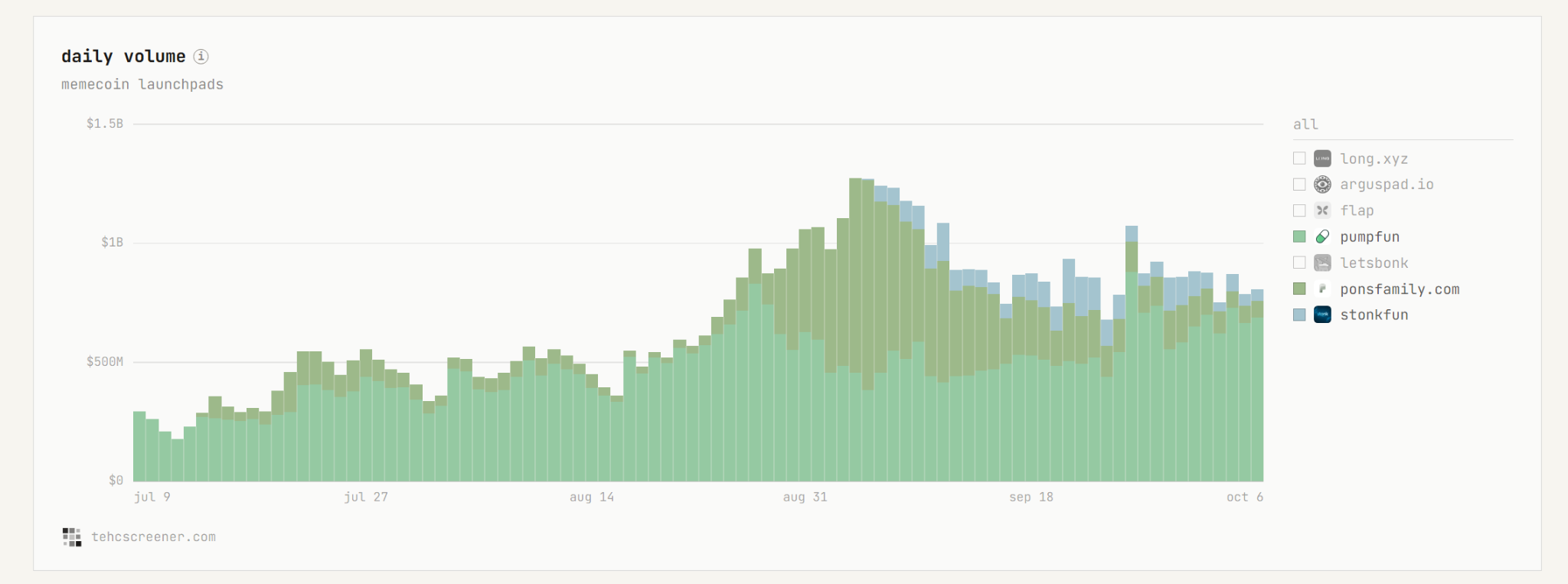
Pump.fun is the oldest of these three launchpads, launched in January 2024, and the largest, with over 80% of daily token launch volume and the number of tokens launched, based on tehscreener data as of this writing.
Although StonkFun is a newer launchpad that started in August 2026, it’s one of the more popular on Solana thanks to its buyback flywheel. A share of trading fees from every V3 pool and from Raydium LaunchLab launches (from the bonding curve vault before migration and the Raydium CPMM pool after) goes toward buying the top 10 tokens by market cap launched on the platform.
Let’s see how these launchpads compare and what their native tokens are.
| Launchpad | Pump.fun | StonkFun | Pons Family |
|---|---|---|---|
| Blockchain | Solana | Solana | Robinhood Chain |
| Supported pairings | Crypto, stablecoins, tokenized stocks | Crypto, stablecoins, tokenized stocks | ETH and ERC-20 tokens, stablecoins, and tokenized stocks |
| Launch mechanism | Bonding curve -> PumpSwap | Raydium LaunchLab curve -> Raydium CPMM | V1: direct Uniswap V3 pool; V2: bonding curve -> Uniswap V4 |
| Creator rewards | Optional creator or holder rewards | Optional holder or community rewards | Creator tax |
| Native token | PUMP | STONK | PONS |
| Token buybacks | ✅ | ✅ | ✅ |
Liquidity providers and platforms
Automated Market Makers (AMMs) such as Raydium, Orca, and Uniswap, along with Pump’s bonding-curve liquidity, make it easy to launch stock-paired meme coins. Once a token graduates, anyone can open a liquidity pool on these platforms and earn a share of trading fees.
These AMMs earn swap fees when trades pass through their pools. Raydium splits pool trading fees, allocating 84% to LPs, 12% to RAY buybacks, and 4% to the treasury.
Uniswap earns swap fees and protocol fees. V2 charges a flat 0.30% fee, automatically added to the pool reserve, while V3 uses fee tiers of 0.05%, 0.30%, and 1%. However, custom V4 hooks can redirect fees elsewhere. Pons V2 charges through its own hook and has zero core pool fees, so Uniswap may not receive part of each Pons trade.
Meteora, on the other hand, retains 10% of trading fees for standard DLMM market-maker liquidity, 20% for DLMM launch pools, and 20% for DAMM V2 pools. The remaining fees go to LPs or other recipients.
Orca benefits from tokenized stocks by collecting fees whenever those tokens trade through its pools, as do the other platforms.
| Liquidity platform | Raydium | Uniswap | Meteora | Orca |
|---|---|---|---|---|
| Trading fees | Common CPMM tier is 0.25% per swap | V2: 0.30% V3: 0.05%, 0.30%, 1% V4: custom fees and hooks |
Fees can include a base fee and dynamic adjustments | From 0.01% to 2%, some pools can charge above the base rate |
| Platform’s share | CPMM splits 16% of trading fees, 84% goes to LPs | V2 allocates 0.05% of trade value to the protocol, V3/V4 depends on the pool | 10% of standard DLMM market-maker fees, 20% for DLMM launch pools and DAMM V2 | 12% of collected trading fees, 87% goes to LPs 1% to Climate Fund |
| Native token | RAY | UNI | MET | ORCA |
| Token buybacks | ✅ | ✅ | ✅ | ✅ |
Note: Orca and Loopscale merged on October 8, 2026, and will operate as Formation.
Trading platforms and DEXs
While you can buy these meme coins directly on their launchpads or on dedicated trading apps like Fomo, you’ll likely get a better deal by trading the token on a decentralized exchange. Options include Raydium, Orca, and Jupiter.
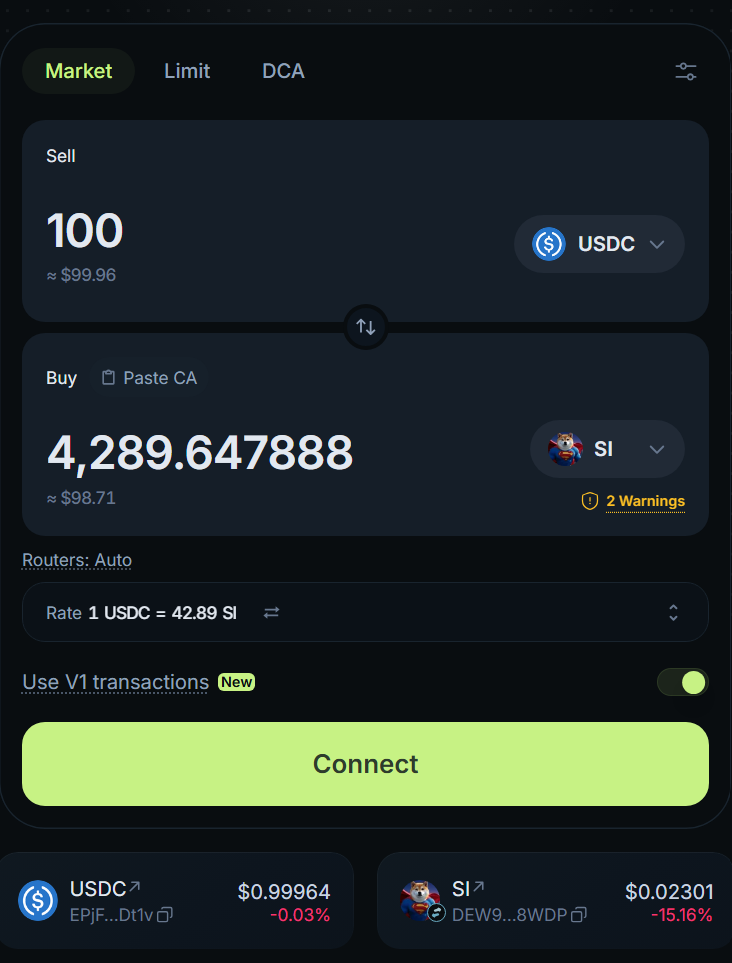
Jupiter’s DEX lets users swap any asset for the meme coin, including USDC, SOL, and other meme coins. Users can also set limit orders, dollar-cost average into their position, or set stop-loss and take-profit orders, a feature that other DEXs lack.
Users on Jupiter pay ultra swap fees ranging from 0% to 0.5%, depending on the token pair. Jupiter also charges an integrator fee whenever a third-party protocol integrates Jupiter Swap into its platform.
Jupiter spends 50% of its fee revenue to buy back its token, JUP. As demand for meme coins and tokenized stocks increases, JUP holders benefit directly if trades occur via the Jupiter DEX.
Risks and verdict
During late 2024 and early 2025, when meme-coin mania was rampant, Raydium had peak daily revenue of $4 to $8 million, while Pump.fun generated $14 to $43 million in daily revenue, according to data from DefiLlama. For comparison, Raydium averaged about $800,000 in daily revenue in September and October 2026, while Pump.fun saw about $8 million in daily revenue during the same period.
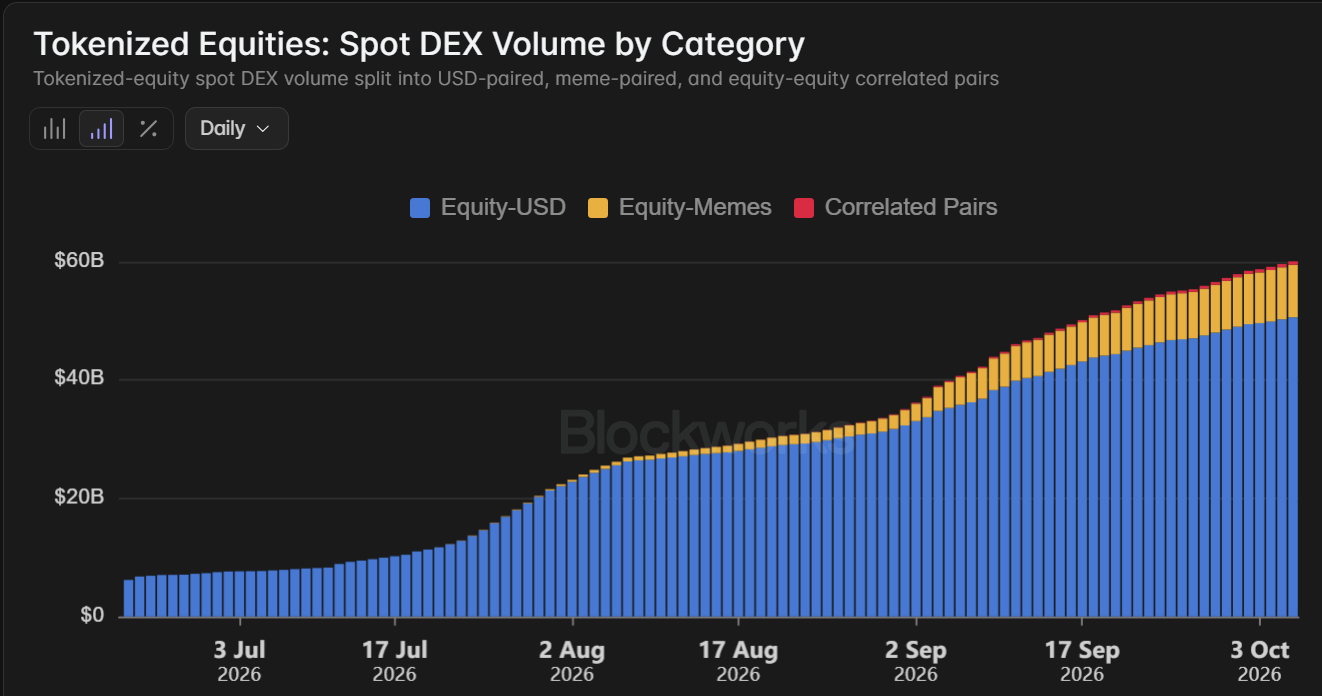
In September 2026, total tokenized stock trading volume on Solana crossed $4.4 billion, and the crypto bull run hadn’t even started yet. When Bitcoin hits new highs in the coming years and crypto hype returns, these numbers will become mind-boggling, and the infrastructure companies powering tokenized stocks and their meme-coin pairings will likely see increased revenue.
However, new companies could emerge that tokenize stocks. We could see new launchpads, liquidity providers, and trading venues that could take a slice of existing players’ profits. This could affect the revenue of the companies dominating the sector now and their native tokens.
New regulations could also affect how these companies operate. Even though most of these platforms are audited, hacks could still happen. Pons V2 audit is underway as of October 10.
Despite these risks, investing in these companies’ tokens is likely less risky than trying to identify the few meme-coin winners among the tens of thousands launched daily, most of which never leave the bonding curve. Infrastructure tokens avoid the high failure rate of meme-coin launches while giving investors exposure to revenue-generating platforms. They still carry token-price and platform risks, though.
As with any crypto investment, do your due diligence and never invest more than you can afford to lose.
This article is for informational and educational purposes only and does not constitute financial or investment advice or a recommendation to buy, sell, or hold any asset. Cryptocurrencies, meme coins, and tokenized stocks carry significant risks, including the potential loss of your entire investment. Market data may change, and past performance does not guarantee future results. Always conduct your own research, consider your financial circumstances and risk tolerance, and consult a qualified financial adviser before making investment decisions.